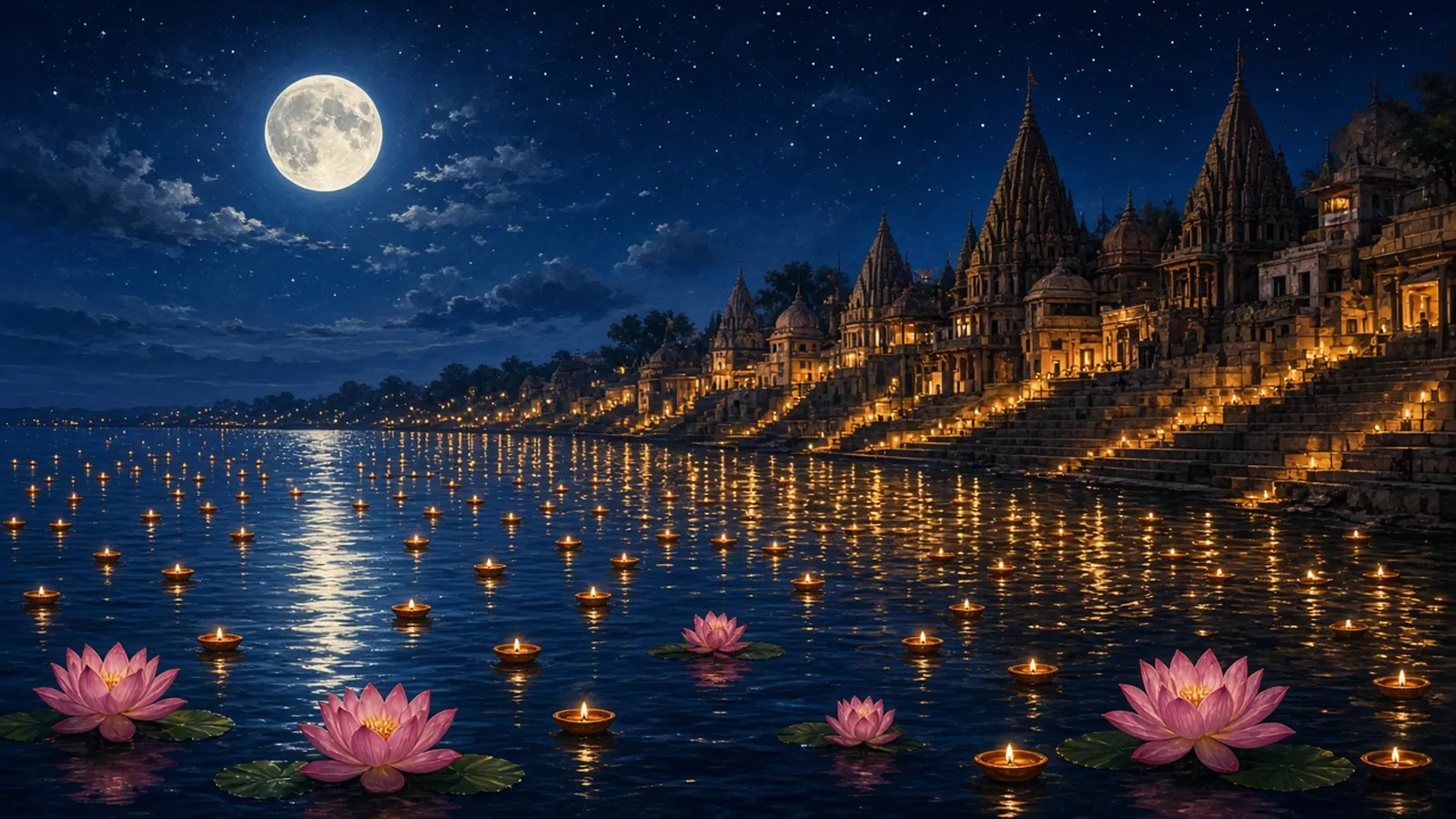
Vaikuntha Chaturdashi 2026 falls on Monday, 23 November 2026, one day before Kartik Purnima and Dev Deepawali. It is one of the rare days in the Hindu calendar when Lord Vishnu and Lord Shiva are worshipped together, as Hari and Hara honouring each other.
The festival is kept on the Shukla Paksha Chaturdashi (14th lunar day of the bright fortnight) of Kartika. Vaikuntha Chaturdashi 2026 is especially significant in Varanasi, where Vishnu is given a place of honour inside the Kashi Vishwanath temple on this one day.
This guide gives the verified Vaikuntha Chaturdashi 2026 date and Nishita muhurat, the Shiva Purana legend of the thousand lotuses, the puja vidhi, regional traditions and the spiritual meaning of the day.
Table of Contents
Vaikuntha Chaturdashi 2026 Date and Nishita Muhurat
According to the Drik Panchang page for Vaikuntha Chaturdashi 2026, the festival is observed on Monday, 23 November 2026. For Vaikuntha Chaturdashi 2026 the Chaturdashi tithi covers almost the whole day, and the main Vishnu puja falls at Nishita, the Hindu midnight.
| Event | Date and Time (IST, New Delhi) |
|---|---|
| Vaikuntha Chaturdashi 2026 | Monday, 23 November 2026 |
| Chaturdashi Tithi Begins | 02:36 AM, 23 November 2026 |
| Chaturdashi Tithi Ends | 11:42 PM, 23 November 2026 |
| Nishitakal (Vishnu Puja) | 11:41 PM, 23 November to 12:35 AM, 24 November (54 mins) |
| Sunrise / Sunset | 06:50 AM / 05:25 PM |
| Brahma Muhurta | 05:03 AM to 05:56 AM |
| Moonrise | 04:11 PM |
| Rahu Kalam | 08:09 AM to 09:29 AM |
| Nakshatra | Bharani up to 02:02 AM, 24 November |
Sunrise, sunset, Brahma Muhurta, moonrise, Rahu Kalam and nakshatra are from the Drik Panchang daily panchang for 23 November 2026. All timings are for New Delhi, so check your own city before you plan the puja.
Two Puja Times: Nishita for Vishnu, Arunodaya for Shiva
Drik Panchang explains that although both deities are worshipped on Vaikuntha Chaturdashi 2026, devotees perform the puja at two different times. Devotees of Lord Vishnu prefer Nishita, the Hindu midnight. Devotees of Lord Shiva prefer Arunodaya, the Hindu dawn.
For Shiva devotees, the early morning bath at Manikarnika Ghat in Varanasi during Arunodaya is very significant. This holy dip is known as Manikarnika Snan on Kartik Chaturdashi.
On Vaikuntha Chaturdashi 2026 the tithi begins at 02:36 AM on 23 November, so the pre-dawn hours of that Monday fall within the tithi. The Brahma Muhurta that morning is 05:03 AM to 05:56 AM, before sunrise at 06:50 AM.
Where Vaikuntha Chaturdashi Sits in the Kartik Festival Calendar
Vaikuntha Chaturdashi 2026 comes at the climax of the holy month of Kartika. Earlier in the same bright fortnight come Dev Uthani Ekadashi, when Lord Vishnu wakes from his four-month yogic sleep, and Tulsi Vivah.
The next day is Kartik Purnima 2026. Drik Panchang gives the Purnima tithi as 11:42 PM on 23 November to 08:23 PM on 24 November. Its Dev Deepawali page lists the Varanasi Pradosh muhurat as 05:08 PM to 07:47 PM on Tuesday, 24 November 2026.
So in Kashi, Vaikuntha Chaturdashi 2026 and Dev Deepawali run back to back.
What Does Vaikuntha Chaturdashi Mean?
The name joins two Sanskrit words. The Wisdom Library entry for Vaikunthacaturdashi explains that Vaikuṇṭhacaturdaśī is a compound of vaikuṇṭha and caturdaśī. It defines the day as the fourteenth of the bright half of Kārtika.
Vaikuntha is the abode of Lord Vishnu. As Wikipedia’s article on Vaikuntha records, it is also called Vishnuloka. Vaishnava literature describes it as the highest realm above the fourteen lokas, where Vishnu’s devotees go upon attaining liberation.
Yet the story of Vaikuntha Chaturdashi 2026 is about Vishnu worshipping Shiva. That is what makes it unique. According to Drik Panchang, it is very rare for Lord Shiva and Lord Vishnu to be worshipped together on the same day, and Vaikuntha Chaturdashi is sacred to the devotees of both.
The Legend of Vaikuntha Chaturdashi 2026: Vishnu’s Thousand Lotuses
The central story behind Vaikuntha Chaturdashi 2026 comes from the Shiva Purana. It is retold on the Drik Panchang festival page and in Wikipedia’s article on Vaikuntha Chaturdashi.
On Kartik Chaturdashi, Lord Vishnu left Vaikuntha and went to Varanasi to worship Lord Shiva. He pledged to worship Shiva with one thousand lotus flowers, singing hymns in Shiva’s glory as he offered each flower.
While offering the lotuses, Vishnu found that the thousandth flower was missing. His own eyes are often compared to lotuses; he is called the lotus-eyed. To complete his vow, Vishnu plucked out one of his eyes and offered it to Shiva in place of the missing flower.
Shiva was deeply pleased by this devotion. He restored Vishnu’s eye and gifted him the Sudarshana Chakra, which became one of Vishnu’s most powerful and sacred weapons.
The Sudarshana Chakra
The Sudarshana Chakra is the divine spinning disc of Vishnu. It is generally shown in his right rear hand, while his other hands hold the Panchajanya conch, the Kaumodaki mace and the lotus.
The word Sudarshana comes from su, “good” or “auspicious”, and darshana, “vision”. Wikipedia notes that in the Rigveda the chakra is described as Vishnu’s symbol as the wheel of time.
Not every text tells the same origin story: the same article records an account in which Vishvakarma fashioned the chakra from the splendour of the Sun. On Vaikuntha Chaturdashi 2026, devotees remember the Shiva Purana account.
The Story of Dhaneshwar
Wikipedia also records a regional folk tale linked to the Varanasi festivities. A Brahmin named Dhaneshwar had spent his life committing many sins. He went to the bank of the Godavari to bathe on a day when crowds were observing Vaikuntha Chaturdashi by offering lit earthen lamps and wicks to the river.
When he died, Yama took his soul to hell, but Shiva told Yama that Dhaneshwar’s sins had been cleansed by the touch of the devotees on Vaikuntha Chaturdashi, and Dhaneshwar was given a place in Vaikuntha.
Manikarnika: Where Vishnu’s Tapas Meets Shiva’s Grace
The Manikarnika link is not accidental. According to Wikipedia’s article on Manikarnika Ghat, the Kashi Khand of the Skanda Purana says that Vishnu dug a well with his Sudarshana Chakra and performed austerities beside it.
Shiva’s pearl-studded earring fell into the well, and when the pleased Shiva offered a boon, Vishnu asked that the place grant mukti (liberation) to all.
So the dawn dip at Manikarnika on Vaikuntha Chaturdashi brings together the same two threads as the lotus legend: Vishnu’s devotion and Shiva’s blessing.
Hari and Hara: Why Shiva and Vishnu Are Worshipped Together
The heart of Vaikuntha Chaturdashi 2026 is the unity of Hari (Vishnu) and Hara (Shiva). Hindu art gives this idea a visible form in Harihara, the dual representation of Vishnu and Shiva, also called Shankaranarayana.
Wikipedia notes that some of the earliest Harihara sculptures, with one half of the image as Vishnu and the other half as Shiva, survive in caves 1 and 3 of the 6th-century Badami cave temples.
The Exchange of Tulsi and Bael at Kashi Vishwanath
On Vaikuntha Chaturdashi 2026, Vishnu is given a special place of honour in the sanctum of the Kashi Vishwanath Temple, one of the twelve Jyotirlinga shrines. Drik Panchang says it is believed that the Vishwanath temple becomes as pious as Vaikuntha on this day.
Both deities are worshipped as though they are worshipping each other:
- Vishnu offers tulsi (holy basil) leaves, normally used in Vishnu worship, to Shiva.
- Shiva in turn offers bael (bilva) leaves, normally offered to Shiva, to Vishnu.
Wikipedia notes that this exchange is otherwise taboo. Bael is considered one of the sacred trees of Hindus, and its leaves are used in the worship of the Shiva lingam. Swapping these two offerings, just for this day, is a ritual statement that the two deities are not rivals.
Vaikuntha Chaturdashi 2026 Puja Vidhi
The steps below for Vaikuntha Chaturdashi 2026 follow the worship rituals recorded by Drik Panchang and Wikipedia. Family and regional customs differ, so follow your own tradition where it varies.
- Bathe early. Begin with a bath. Shiva devotees in Varanasi take the Manikarnika Snan at Arunodaya; at home, bathe before sunrise if you can.
- Take the vow and fast. Devotees begin the puja after bathing and fast for the whole day.
- Worship Shiva and Vishnu together. Offer akshat (turmeric-coloured rice), sandalwood paste, Ganga water, flowers, incense and camphor to both deities.
- Exchange the sacred leaves. Following the Kashi custom, offer tulsi to Lord Shiva and bael leaves to Lord Vishnu.
- Offer lamps. Light earthen diyas with cotton wicks, the special offering of the day.
- Nishita puja for Vishnu. At Hindu midnight (11:41 PM to 12:35 AM in New Delhi for Vaikuntha Chaturdashi 2026), offer lotuses to Lord Vishnu while reciting the Vishnu Sahasranama.
- Avoid Rahu Kalam for beginnings. Drik Panchang advises that no new auspicious work be started during Rahu Kalam, which on 23 November 2026 is 08:09 AM to 09:29 AM in New Delhi.
Reciting the Vishnu Sahasranama
The Vishnu Sahasranama is a Sanskrit hymn listing the 1,000 names of Vishnu, one of the most sacred and popular stotras in Hinduism. Its most popular version is in the Anushasana Parva of the Mahabharata, and other versions exist in the Padma, Skanda and Garuda Puranas.
Offering a lotus with each name mirrors the legend of Vaikuntha Chaturdashi 2026. Drik Panchang publishes the 1000 names of Lord Vishnu (Sahasranamavali) with meanings, beginning “Om Vishwasmai Namah” and “Om Vishnave Namah”.
How Vaikuntha Chaturdashi 2026 Is Celebrated Across India
Drik Panchang notes that most temples in Varanasi observe Vaikuntha Chaturdashi, and that it is also kept in Rishikesh, Gaya and many cities in Maharashtra.
Varanasi
In Kashi the day centres on the Hari-Hara worship at Kashi Vishwanath and the dawn dip at Manikarnika Ghat. Wikipedia notes that women, especially older women, outnumber others in offering prayers on Vaikuntha Chaturdashi in Varanasi.
Rishikesh: Deep Daan Mahotsav
In Rishikesh, Vaikuntha Chaturdashi is observed as the Deep Daan Mahotsav, marking Vishnu’s awakening from his long sleep. As a mark of environmental care, the lamps are made of flour, which dissolves in water, instead of baked clay. The lit lamps are floated on the Ganga in the evening, with cultural programmes.
Gaya: Vishnupad Mandir
The Vishnupad Mandir in Gaya, on the banks of the Phalgu river, enshrines a 40 cm footprint of Vishnu imprinted in solid rock. According to Wikipedia, the temple celebrates its main festival during this period.
Maharashtra
In Maharashtra, Vaikuntha Chaturdashi is observed by the Marathas according to a custom set by Chhatrapati Shivaji and his mother Jijabai, and by the Gaud Saraswat Brahmins in a slightly different form.
Wikipedia retells a Maratha folk story: at Raigad, Jijabai wished to offer a thousand untouched white lotuses to Shiva, and the bodyguard Vikram Dalvi cut the stems with arrows so that no hand touched them.
At the Grishneshwar Jyotirlinga near Ellora, Vishnu is offered bael leaves and Shiva is offered tulsi, portraying the union of Vishnu and Shiva. In Nashik, the Tilbhandeshvar linga is adorned with a silver mask as Ardhanarishvara, and the day is one of the three main festivals of the Tilbhandeshvar and Kapaleshwar temples.
South India and Other Customs
Wikipedia notes that the festival is prominently celebrated in Vishnu temples such as Srirangam in Tamil Nadu, the Tirupati Srinivasa temple in Andhra Pradesh and the Udupi Sri Krishna Matha in Karnataka.
Vaikuntha Chaturdashi 2026 Fasting and Observance Guidelines
For Vaikuntha Chaturdashi 2026, the sources above describe a whole-day fast that ends after worship, but they do not prescribe one fixed menu. Keep the fast in the way your family or sampradaya teaches. These practical points can help:
- Check local timings. The Nishita window and tithi times above are for New Delhi; use Drik Panchang for your own city.
- Honour both deities. The spirit of Vaikuntha Chaturdashi 2026 is harmony. It is a day to put aside any sense of “my god versus your god”.
- Light lamps with care. Follow the Rishikesh example: if you float lamps, choose ones that will not pollute the river.
If you are unwell, elderly or pregnant, choose a lighter observance and consult a doctor.
Spiritual Meaning of Vaikuntha Chaturdashi 2026
The lotus legend teaches surrender. Vishnu, the Lord of Vaikuntha himself, was ready to offer his own eye to complete a vow of worship. The gift he received, the Sudarshana Chakra, is linked with the wheel of time and with protection of dharma.
The exchange of tulsi and bael on Vaikuntha Chaturdashi 2026 teaches unity. Sectarian lines that seem firm the rest of the year are deliberately crossed on this one night.
Hindu thinkers have long pointed to this oneness. Wikipedia’s article on the Vishnu Sahasranama notes that Adi Shankara, in his commentary, cites the Kaivalya Upanishad verse “He is both Brahma and Shiva” to emphasise “the non-difference between Shiva and Vishnu”.
The name of the day completes the lesson. By honouring Hara, Hari’s devotee draws closer to Vaikuntha, the realm “without anxiety”. Seen this way, Vaikuntha Chaturdashi 2026 is a reminder that sincere devotion to one form of the Divine opens the door to all.
Read More on InVedas
- A Tale of Two Temples: The Spiritual Bridge Between Rameshwaram and Kashi Vishwanath
- 108 Divya Desams: Exploring the Sacred Vishnu Temples
- Jyotirlingas vs. Shivlings: Getting to Know the Differences
- Kaal Bhairav Jayanti 2026: Date, Ashtami Tithi Timings, Puja Vidhi, Legend and Mantras
Frequently Asked Questions
When is Vaikuntha Chaturdashi 2026?
Vaikuntha Chaturdashi 2026 is on Monday, 23 November. Per Drik Panchang, Chaturdashi tithi runs from 02:36 AM to 11:42 PM that day (New Delhi), and the Nishita puja is from 11:41 PM to 12:35 AM on 24 November.
Why is Vaikuntha Chaturdashi celebrated?
It marks the Shiva Purana story in which Lord Vishnu worshipped Lord Shiva in Varanasi with a thousand lotuses and offered his own lotus-like eye when one flower was missing. Pleased, Shiva restored the eye and gave Vishnu the Sudarshana Chakra.
Which god is worshipped on Vaikuntha Chaturdashi?
Both Lord Vishnu and Lord Shiva. Vishnu devotees worship at Nishita (Hindu midnight), while Shiva devotees prefer Arunodaya (dawn). At Kashi Vishwanath, Vishnu is offered bael leaves and Shiva is offered tulsi.
What is Manikarnika Snan?
It is the holy dip at Manikarnika Ghat in Varanasi taken at dawn (Arunodaya) on Kartik Chaturdashi, the day of Vaikuntha Chaturdashi.
Is Vaikuntha Chaturdashi the same as Vaikuntha Ekadashi?
No. Vaikuntha Chaturdashi is the Kartika Shukla Chaturdashi, the day before Kartik Purnima. Vaikuntha Ekadashi, also called Mukkoti Ekadashi, is a separate Ekadashi, popular in the Tamil calendar, when the Vaikuntha Dwaram is believed to open.
How is Vaikuntha Chaturdashi related to Dev Deepawali?
Vaikuntha Chaturdashi falls one day before Kartik Purnima, when Varanasi celebrates Dev Deepawali. In 2026 they fall on 23 and 24 November.
May Hari and Hara bless your home with peace and devotion. Om Namo Narayanaya. Om Namah Shivaya.