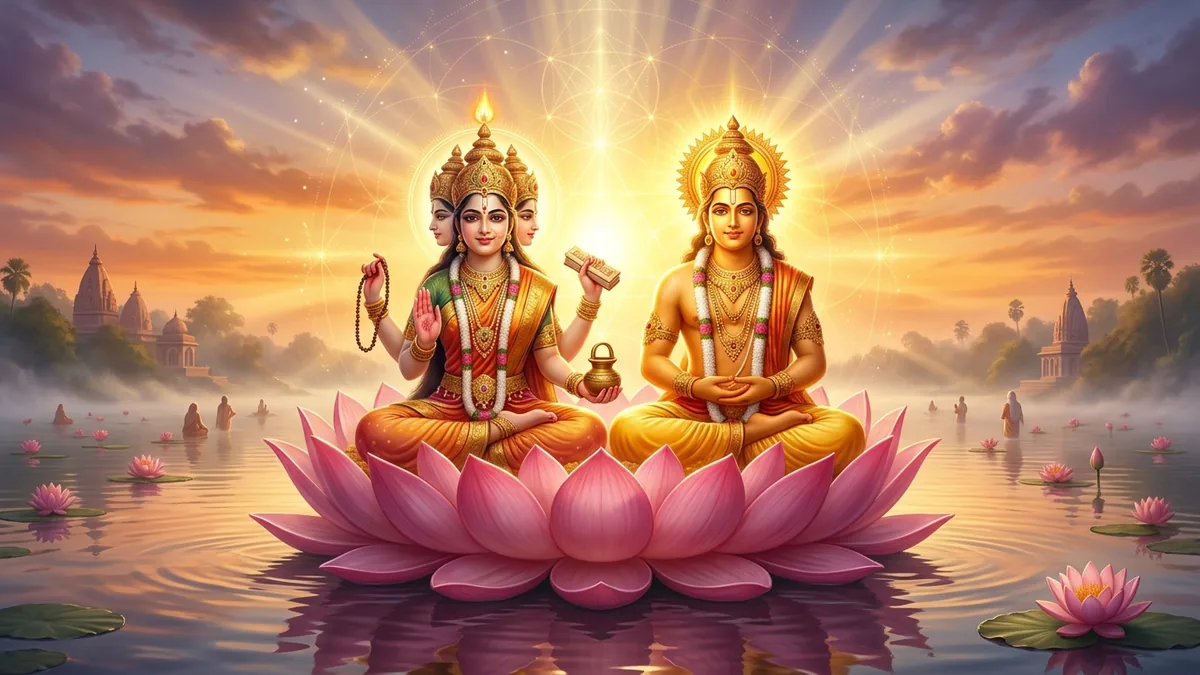
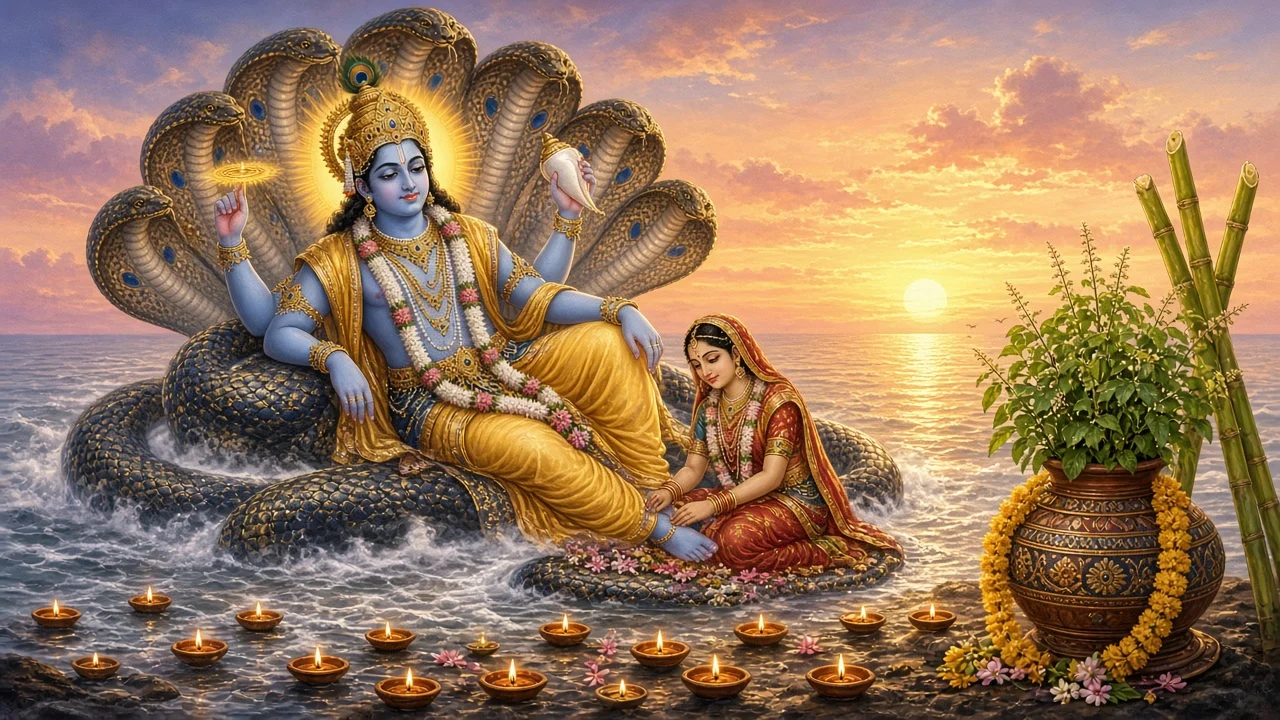
Dev Uthani Ekadashi 2026 falls on Friday, 20 November 2026, the eleventh lunar day of the bright fortnight of Kartika. Also called Prabodhini Ekadashi or Devutthana Ekadashi, it is the day Lord Vishnu is believed to wake from his four-month Yoga Nidra, closing the sacred period of Chaturmas and opening the season of Tulsi Vivah and Hindu weddings.
In this complete guide you will find the verified Dev Uthani Ekadashi date and Parana (fast-breaking) time for 2026, the meaning of the festival, the Vrat Katha narrated by Lord Krishna, a step-by-step puja vidhi drawn from that Katha, fasting rules, the Tulsi Vivah 2026 date, and how the day is celebrated across India.
Table of Contents
Dev Uthani Ekadashi 2026 Date and Parana Time
According to the Drik Panchang listing for Prabodhini Ekadashi 2026, the Ekadashi tithi spans two calendar days, so two fasting dates are given. All timings below are for New Delhi (IST); timings in your city may differ by a few minutes.
| Event | Date and Time (New Delhi, IST) |
|---|---|
| Ekadashi Tithi Begins | 07:15 AM, Friday, 20 November 2026 |
| Ekadashi Tithi Ends | 06:31 AM, Saturday, 21 November 2026 |
| Dev Uthani Ekadashi (Smarta) fast | Friday, 20 November 2026 |
| Parana on 21 November | 01:11 PM to 03:18 PM |
| Hari Vasara ends on Parana day | 12:07 PM, 21 November |
| Gauna / Vaishnava Devutthana Ekadashi | Saturday, 21 November 2026 |
| Parana for Gauna Ekadashi on 22 November | 06:49 AM to 08:56 AM |
Which Day Should You Fast: 20 or 21 November?
When the Panchang shows two Ekadashi days, Drik Panchang advises that Smarta householders with family observe the fast on the first day only, which is 20 November in 2026. The second (Gauna) day is suggested for sannyasis, widows and those seeking moksha, and it coincides with the Vaishnava Ekadashi. Drik Panchang also lists 21 November 2026 as Guruvayur Ekadashi. If your family follows a specific sampradaya or temple calendar, follow that tradition.
Parana Rules for Breaking the Fast
Parana means breaking the Ekadashi fast. It is done after sunrise on the next day and should be completed within Dwadashi tithi. The fast should not be broken during Hari Vasara, the first quarter of Dwadashi. Morning (Pratahkal) is usually the preferred time and midday (Madhyahna) is avoided. In 2026, Hari Vasara ends at 12:07 PM on 21 November, which is why the Smarta Parana window in Delhi opens only at 01:11 PM.
Related Dates Around Dev Uthani Ekadashi 2026
| Observance | 2026 Date | Why It Matters |
|---|---|---|
| Devshayani Ekadashi | Saturday, 25 July 2026 | Vishnu’s Yoga Nidra and Chaturmas begin |
| Dev Uthani Ekadashi | Friday, 20 November 2026 | Vishnu awakens; Chaturmas ends |
| Tulasi Vivah | Saturday, 21 November 2026 | Ceremonial marriage of Tulsi and Shaligram |
| Kartika Purnima | Tuesday, 24 November 2026 | Full moon of Kartika, celebrated as Dev Deepawali |
| Utpanna Ekadashi | Friday, 4 December 2026 | Next Ekadashi, Margashirsha Krishna Paksha |
These dates are taken from Drik Panchang’s Devshayani Ekadashi 2026, Tulasi Vivah 2026, Purnima 2026 and Ekadashi 2026 calendars for New Delhi.
What Is Dev Uthani Ekadashi? Meaning and Other Names
The name is simple to unpack. Dev means the deity, and Uthani or Utthana means rising or waking. Dev Uthani Ekadashi is therefore the Ekadashi on which the Lord rises. The Sanskrit name Prabodhini Ekadashi carries the same idea: prabodhini means the one that awakens.
As the encyclopedic entry on Prabodhini Ekadashi records, the day is known by many names in different regions:
- Prabodhini Ekadashi, the awakening eleventh
- Devutthana or Deva Uttana Ekadashi
- Vishnu Prabodhini and Hari Prabodhini
- Deva Prabodhini Ekadashi, Uttana Ekadashi and Deothan
- Thulo Ekadashi, the biggest of the Ekadashis, in Nepal
Whatever the name, the core belief is the same. Lord Vishnu, who went into Yoga Nidra on Devshayani Ekadashi in the month of Ashadha, awakens on this Kartika Shukla Ekadashi, and with him the cycle of auspicious household ceremonies resumes.
Chaturmas and Lord Vishnu’s Yoga Nidra
Dev Uthani Ekadashi is the closing day of Chaturmas (Chaturmasya), literally the four months. As the overview of Chaturmasya explains, in Hinduism this period runs from Shayani Ekadashi, when Vishnu enters his spiritual sleep, until he wakes on Prabodhini Ekadashi. Householders mark these months by giving up a favourite food or keeping special fasting vows.
In the image of the sleeping Lord, Vishnu reclines on the serpent Shesha in Kshira Sagara, the ocean of milk. This form is closely related to Ksirodakasayi Vishnu, which we discuss in our article on the Trinity of Vishnu.
The Chaturmasya Vidhan, a dialogue between Lord Krishna and Arjuna presented on Drik Panchang’s Chaturmasya Vidhan page, links the Lord’s rest to the Sun: when Surya enters Karka Rashi, Vishnu goes to rest, and when Surya enters Tula, the Lord awakens. The same text says the Chaturmasya fast runs from Devshayani Ekadashi to Devotthan Ekadashi and should conclude on Kartika Shukla Dwadashi.
The practical meaning for devotees is clear. Anything you gave up during Chaturmas, such as a particular food, can be taken up again from this day. The Prabodhini Katha says exactly this: whatever object a person renounced during the Chaturmasya vow should be resumed from Dev Uthani Ekadashi.
Dev Uthani Ekadashi Vrat Katha: Narada and Brahma
The Prabodhini Ekadashi Vrat Katha is told by Lord Krishna to Arjuna. Krishna narrates an older conversation between Devarshi Narada and his father, Lord Brahma. Narada, the wandering sage whose devotion we explored in the tale of Narada and Maya, asks Brahma what merit the Prabodhini fast brings and how it should be kept.
Brahma replies that the fast of Kartika Shukla Ekadashi gives merit equal to a thousand Ashvamedha and a hundred Rajasuya yajnas. He says that eating one meal in the evening on this day removes the sins of two lifetimes, while fasting through the whole day removes the sins of seven.
Brahma gives special weight to the night vigil (jagaran). Those who stay awake on this night in devotion, he says, lift ten generations before and after them to Vishnu Loka. He adds that in Kartika, the Lord is pleased more by listening to sacred stories than by charity alone.
Flowers and Leaves Offered to Lord Vishnu
A memorable part of the Katha is its list of offerings and their fruits. Brahma names:
- Tulsi leaves, said to destroy the sins of ten thousand births when offered in Kartika
- Bilva leaves, which lead to liberation
- Agastya flowers, before whose worshippers even Indra folds his hands
- Kadamba flowers, which free one from the torments of Yama
- Lotus, Ketaki, Champaka, Bakula, Ashoka, Kanera and rose flowers
- Durva grass and Shami leaves
The message is not that one must collect every flower. It is that the Lord should be worshipped generously and with love, according to one’s means.
Dev Uthani Ekadashi Puja Vidhi: Step by Step
The procedure below follows the steps Brahma describes to Narada in the Katha. Family and regional customs vary, so adapt it to your own tradition.
- Wake up in Brahma Muhurta, take a bath and complete your morning rituals. If a full bath is not possible because of illness or travel, our guide to Sanketik Snan explains the traditional symbolic bath.
- Take the sankalp (resolve) to fast. The Katha gives the prayer in essence: O Lord, today I will refrain from food and eat on the next day, please protect me.
- Worship Lord Vishnu with flowers, agarwood, incense, lamps and other offerings, without stinginess.
- Offer arghya (water) to the Lord from a conch shell.
- Spend the night near the Lord with bhajan, kirtan, music and the reading of sacred stories.
- In the morning, bathe again, sing the Lord’s praises and complete the worship.
- Honour the Guru and offer food and dakshina to Brahmins, then break the fast in the Parana window.
Many devotees also chant the Dvadashakshara mantra Om Namo Bhagavate Vasudevaya and recite the Vishnu Sahasranama on Ekadashi; both are listed among the Ekadashi recitations on Drik Panchang.
What to Donate on Dev Uthani Ekadashi
The Katha links each personal vow kept in Kartika to a matching donation. Those who slept on the ground donate a bed; those who kept silence donate sesame with gold; those who gave up salt donate sugar; and those who lit temple lamps daily donate a lamp with ghee and wicks. Among grains, rice is named as the preferred donation.
Dev Uthani Ekadashi Fasting Rules: What to Eat and Avoid
Drik Panchang’s guide to Ekadashi fasting food describes four kinds of Ekadashi fast from the religious texts. You choose one at the time of sankalp, based on your health and will power:
| Type of Fast | What It Means |
|---|---|
| Jalahar | Fasting with water only |
| Ksheerbhoji | Fasting on milk and milk products |
| Phalahari | Fasting on fruits only, avoiding leafy vegetables |
| Naktabhoji | A single meal just before sunset, without any grains |
On Ekadashi, all grains and cereals are avoided, including rice, wheat, pulses and beans. Common fasting foods include sabudana, singhada (water caltrop), shakarkandi (sweet potato), potatoes and groundnuts. Kuttu atta and samak rice are widely used, but Drik Panchang notes that their status is debated because they are considered pseudo-grains, and suggests avoiding them.
Above all, the guide reminds us that fasting is a form of penance and not a feast day, so eat simply. Elderly people, pregnant women and anyone with a medical condition should choose a lighter form of fast and consult their doctor.
Tulsi Vivah 2026 and Its Link to Dev Uthani Ekadashi
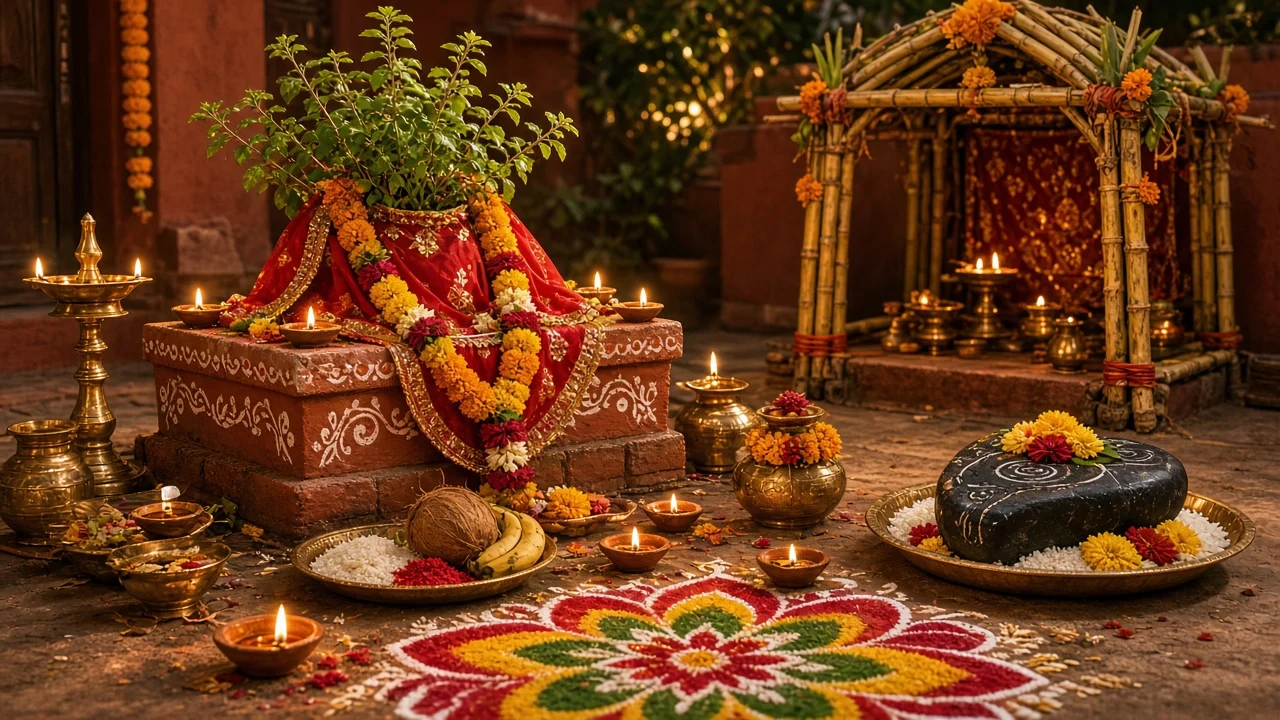
In 2026, Drik Panchang lists Tulasi Vivah on Saturday, 21 November, with Dwadashi tithi from 06:31 AM on 21 November to 04:56 AM on 22 November (New Delhi). Tulsi Vivah is the ceremonial marriage of the Tulsi plant, revered as Goddess Tulsi, with Lord Vishnu in the form of the Shaligram stone, or with Lord Krishna.
The timing varies by region. Drik Panchang notes that the Padma Purana mentions Kartika Shukla Navami, while other scriptures treat the five days from Prabodhini Ekadashi to Kartika Purnima as especially auspicious for the ritual. Some families therefore perform it on Dev Uthani Ekadashi itself, others on Dwadashi.
The Legend of Vrinda and Jalandhara
As summarised in the Tulasi Vivaha article, texts such as the Skanda Purana, Padma Purana and Shiva Purana tell of Vrinda, a pious devotee of Vishnu married to the asura Jalandhara. Her chastity made her husband invincible, until Vishnu took Jalandhara’s form and broke it, allowing Shiva to defeat him. Vrinda cursed Vishnu and gave up her life. In popular tradition, Vishnu blessed her to become the Tulsi plant and, as the Shaligram, married her on Prabodhini Ekadashi, which Tulsi Vivah commemorates.
How Tulsi Vivah Is Performed
- In Maharashtra, a white cloth (antahpata) is held between Tulsi and Vishnu while Mangalashtaka mantras are recited, then rice mixed with vermilion is showered on the couple.
- A couple without a daughter often bears the cost and acts as Tulsi’s parents, performing kanyadaan.
- In Andhra Pradesh and Telangana it is celebrated as Tulasi Kalyanam, and Vishnu is worshipped in the form of an amla branch.
- In Vrindavan and the Braj region, Tulsi Vivah is held in homes and temples with full wedding customs.
How Dev Uthani Ekadashi Is Celebrated Across India
The festival takes many forms across the country, as recorded in the sources linked above:
- Pandharpur, Maharashtra: Varkari pilgrims throng the Vithoba temple for the Kartiki fair, which continues for five days until Kartika Purnima. A minister of the state performs the official mahapuja.
- Mount Girnar, Gujarat: pilgrims walk the 32-km Lili Parikrama around the mountain over two days.
- Pushkar, Rajasthan: the Pushkar fair begins on this day and runs until Kartika Purnima, honouring Lord Brahma.
- Sugarcane harvest: in many farming communities the day marks the start of the sugarcane harvest, and canes are offered in the puja.
- Swaminarayan tradition: the day commemorates the diksha of Swaminarayan by his guru Ramanand Swami.
The end of Chaturmas, when marriages are avoided, is also traditionally regarded as the beginning of the Hindu wedding season.
Spiritual Significance of Dev Uthani Ekadashi
The image of a sleeping and waking God carries a lesson for the devotee. The four months of Chaturmas are a time of restraint and inward focus; Dev Uthani Ekadashi is the moment that inner discipline turns outward again into celebration, marriage and new beginnings. The Lord’s waking reminds us to wake our own devotion.
It is also a festival of Vishnu as the sustainer of the world. Readers who want to go deeper into Vishnu’s forms can explore our posts on the 108 Divya Desams, the sacred Vishnu temples praised by the Alvars.
Conclusion
Dev Uthani Ekadashi in 2026 falls on Friday, 20 November, with the Gauna or Vaishnava fast on Saturday, 21 November, and Tulsi Vivah on 21 November. Keep the fast according to your capacity, worship Lord Vishnu with Tulsi and flowers, stay awake in kirtan if you can, and break the fast in the Parana window for your city. As the Katha says, even listening to the Lord’s stories in Kartika brings great merit.
Read More on InVedas
If you enjoyed this guide, these articles from InVedas will deepen your understanding of Lord Vishnu and Hindu ritual:
- 108 Divya Desams: Exploring the Sacred Vishnu Temples
- Vishnu Avatar and the Evolution of Life on Earth
- Sanketik Snan: Meaning, Method, Mantra, Rules and Benefits
- Spirits of the Cosmos: Discovering the 33 Koti Devtas
Dev Uthani Ekadashi FAQs
When is Dev Uthani Ekadashi in 2026?
Dev Uthani Ekadashi 2026 is on Friday, 20 November 2026. The Ekadashi tithi runs from 07:15 AM on 20 November to 06:31 AM on 21 November (New Delhi). The Gauna or Vaishnava Devutthana Ekadashi is on Saturday, 21 November 2026.
What is the Parana time for Dev Uthani Ekadashi 2026?
For the Smarta fast of 20 November, Parana in New Delhi is on 21 November from 01:11 PM to 03:18 PM, after Hari Vasara ends at 12:07 PM. For the Gauna fast of 21 November, Parana is on 22 November from 06:49 AM to 08:56 AM.
Is Prabodhini Ekadashi the same as Dev Uthani Ekadashi?
Yes. Prabodhini Ekadashi, Devutthana Ekadashi, Dev Uthani Ekadashi and Deothan are names of the same Kartika Shukla Ekadashi, the day Lord Vishnu is believed to awaken from Yoga Nidra.
When is Tulsi Vivah in 2026?
Drik Panchang lists Tulasi Vivah on Saturday, 21 November 2026, on Kartika Shukla Dwadashi. Depending on family and regional tradition, it may be performed on any day from Prabodhini Ekadashi to Kartika Purnima (24 November 2026).
Can we eat rice on Dev Uthani Ekadashi?
No. Rice and all other grains, cereals, pulses and beans are avoided on every Ekadashi, including Dev Uthani Ekadashi. Fruits, milk, sabudana, sweet potato, potatoes and groundnuts are common fasting foods.
Why do Hindu weddings start after Dev Uthani Ekadashi?
Marriages are traditionally avoided during Chaturmas, the four months when Lord Vishnu is believed to be in Yoga Nidra. When he awakens on Dev Uthani Ekadashi, Chaturmas ends and the wedding season traditionally begins, starting with the divine marriage of Tulsi Vivah.