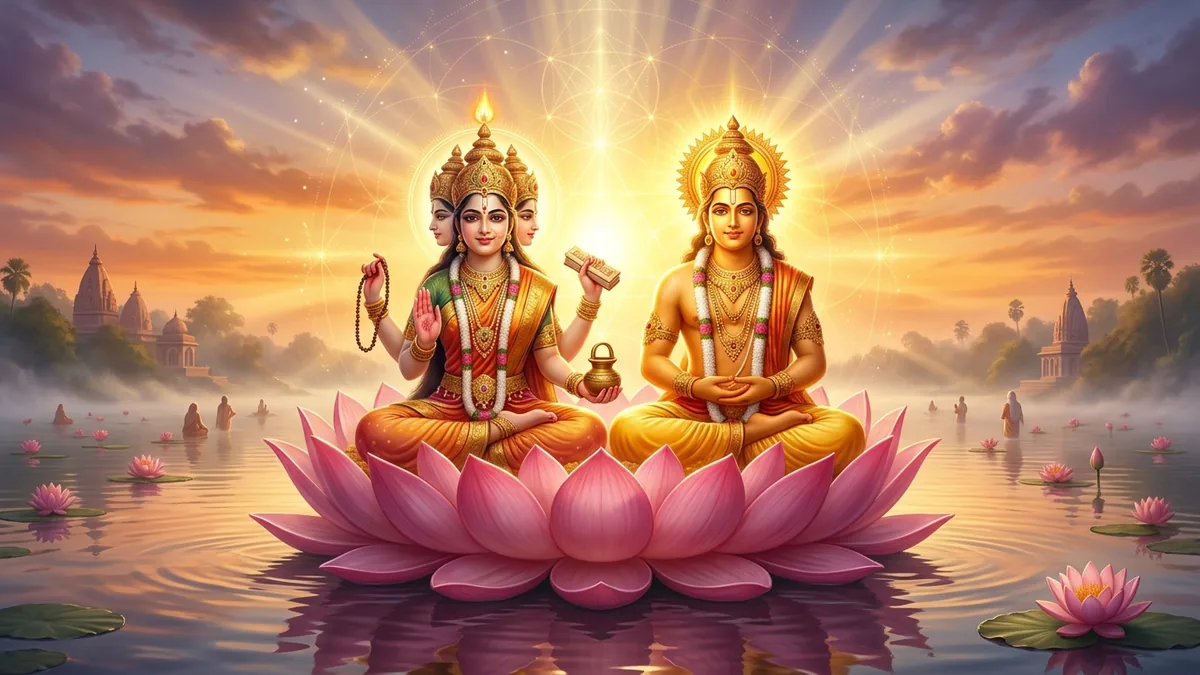
Understanding the Gayatri Mantra Meaning and Spiritual Science is one of the most transformative spiritual journeys in Sanatan Dharma. Revered across millennia as the Veda-Mata (Mother of the Vedas) and the supreme mantra of spiritual illumination, the Gayatri Mantra is far more than a ceremonial prayer. It is a precise sonic and metaphysical blueprint revealed to the Vedic seer Brahmarshi Vishwamitra. As modern science and ancient contemplation converge in 2026, researchers and practitioners alike are recognizing the Gayatri Mantra as a profound technology of consciousness—harmonizing the nervous system, elevating cognitive coherence, and awakening the dormant solar intelligence within the human heart.
In this scholarly and comprehensive exploration curated by InVedas, we delve deep into the Rigvedic origins of the mantra, provide an exhaustive word-by-word grammatical analysis (*Padachheda*), analyze the esoteric significance of its 24 sacred syllables, examine contemporary neuro-acoustic and bio-electromagnetic research, and outline the authentic Vedic method of chanting during the sacred Sandhyas.
Table of Contents
1. Scriptural Origins in the Rigveda and the Revelation to Vishwamitra
The Gayatri Mantra first appears in the oldest monument of human spirituality, the Rigveda Samhita, situated in Mandala 3, Sukta 62, Verse 10 (RV 3.62.10). It is traditionally attributed to Rishi Vishwamitra Gathina, a king who performed austere penances (*tapas*) to transform from a Rajarshi (royal sage) into a Brahmarshi (cosmic seer). Through this intense penance, Vishwamitra directly perceived (*drishti*) this mantra vibrating in the eternal akashic field.
Beyond the Rigveda, the mantra is reverently woven into the other three Vedic Samhitas: the Yajurveda (Shukla Yajurveda, Vajasaneyi Samhita 3.35, 22.9, 30.2, 36.3), the Samaveda, and the Atharvaveda (hymn 19.71). In the Chandogya Upanishad (3.12.1), it is famously declared: “Gāyatrī vā idaṁ sarvaṁ bhūtaṁ yad idaṁ kiṁ ca”—”Gayatri indeed is everything that exists in this entire manifest cosmos.”
The presiding deity (*Devata*) of the mantra is Savitr (सवितृ), the divine, self-luminous solar power responsible for vivifying, stimulating, and generating all planes of existence. Savitr is not merely the astronomical physical sun, but the transcendent spiritual light behind the celestial disc that illumines the intellect of all conscious beings.
2. The Sacred Sanskrit Verse: Devanagari, IAST & Word-by-Word Analysis
The complete Gayatri Mantra, as recited in classical daily liturgy, begins with the cosmic primordial sound (Pranava Om) followed by the three great cosmic utterances (*Maha Vyahritis*):
ॐ भूर्भुवः॒ स्वः॒ ।
तत्स॑वि॒तुर्वरे॑ण्यं॒ भर्गो॑ दे॒वस्य॑ धीमहि ।
धियो॒ यो नः॑ प्रचो॒दया॑त् ॥Oṁ Bhūr Bhuvaḥ Svaḥ ।
Tat Savitur Vareṇyaṁ Bhargo Devasya Dhīmahi ।
Dhiyo Yo Naḥ Pracodayāt ॥— Rigveda 3.62.10 & Shukla Yajurveda 36.3
To extract the metaphysical brilliance of this prayer, Sanatan scholarship analyzes it through Padachheda (grammatical word separation) and Anvaya (syntactical prose order):
| Sanskrit Word | IAST Transliteration | Literal Etymology & Spiritual Meaning |
|---|---|---|
| ॐ | Om | The primordial cosmic sound, the supreme unmanifest Parabrahman. |
| भूः | Bhūḥ | The terrestrial physical plane (Bhur-loka), earth, material manifestation. |
| भुवः | Bhuvaḥ | The intermediate atmospheric/vital plane (Bhuvar-loka), vital energy (Prana). |
| स्वः | Svaḥ | The celestial mental/spiritual plane (Svar-loka), divine light, heaven. |
| तत् | Tat | That; referring to the supreme, transcendental, unmanifest Ultimate Reality. |
| सवितुः | Savituḥ | Of Savitr; the divine solar source, creator, and illuminator of cosmic energy. |
| वरेण्यम् | Vareṇyam | Most adorable, supreme, worthy of being chosen and worshipped above all. |
| भर्गः | Bhargaḥ | Effulgence, radiant divine brilliance that destroys ignorance and karmic impurities. |
| देवस्य | Devasya | Of the divine Lord, the luminous celestial being. |
| धीमहि | Dhīmahi | We meditate upon; we absorb into our heart and contemplative consciousness. |
| धियः | Dhiyaḥ | Intellects, faculties of perception, spiritual discernment, and intuitive wisdom (Buddhi). |
| यः | Yaḥ | Who; the divine self-luminous Savitr. |
| नः | Naḥ | Our; collective spiritual awakening (not an individualistic prayer). |
| प्रचोदयात् | Pracodayāt | May awaken, inspire, guide, and direct toward the path of Truth and Righteousness. |
Unified Philosophical Translation:
“We meditate upon that supreme, most adorable effulgence of the divine Savitr, the creator and illuminator of the three worlds. May that divine light awaken, illuminate, and guide our intellects toward cosmic truth and supreme liberation.”
3. The 24 Syllables (Aksharas) and Their Presiding Cosmic Energies
In Vedic prosody (*Chandas*), the Gayatri meter is characterized strictly by three padas (lines) of eight syllables each, totaling precisely 24 syllables (*tripadā gāyatrī*). In the esoteric teachings of the Gopatha Brahmana and subsequent tantric scriptures, each of the 24 syllables corresponds to a specific gland in the subtle human anatomy, a cosmic Shakti, and an aspect of universal energy.
The 24 syllables act as sonic keys unlocking the 24 nerve centers (Granthis and Chakras) along the Sushumna Nadi:
- Pāda 1 (8 Syllables): tat – sa – vi – tur – va – re – ṇyaṁ — Connected to the physical and sensory faculties, awakening self-mastery and physical stamina.
- Pāda 2 (8 Syllables): bhor – go – de – va – sya – dhī – ma – hi — Connected to emotional refinement, vital force (Prana), and intellectual illumination.
- Pāda 3 (8 Syllables): dhi – yo – yo – naḥ – pra – co – da – yāt — Connected to intuitive higher consciousness, transcendental bliss, and spiritual liberation (Moksha).
Furthermore, classical tradition links the 24 syllables of Gayatri to the 24,000 verses of the Valmiki Ramayana, where the opening letter of each thousandth shloka mirrors the consecutive syllables of the Gayatri Mantra, underscoring its foundational role across Sanatan literary history.
4. The Spiritual Science and Neuro-Acoustics of Gayatri Chanting
In 2026, modern neuro-acoustic science and bio-resonance studies are providing empirical validation for what Vedic rishis experienced through inner perception. When chanted according to traditional Vedic phonetics (*Shiksha*), the Gayatri Mantra produces distinct neurological and physiological phenomena:
- Acupressure Tongue Reflexology: As the tongue touches the hard and soft palates to articulate the 24 Vedic phonemes, it strikes 24 specific reflex points located along the palate. These tactile contacts stimulate the hypothalamus, pituitary, and pineal glands, triggering balanced endocrine secretion.
- Vagal Nerve Activation & Heart Rate Variability (HRV): The elongated exhalation required to chant one full cycle of the Gayatri Mantra in a single breath (~10 to 12 seconds) shifts the autonomic nervous system from sympathetic fight-or-flight to parasympathetic deep rejuvenation. Clinical HRV measurements demonstrate enhanced autonomic balance and cellular oxygenation.
- Alpha and Theta Brainwave Synchronization: Electroencephalogram (EEG) research reveals that rhythmic Gayatri chanting induces synchronous alpha wave activity (8–12 Hz) across both cerebral hemispheres. This state fosters heightened creative intuition, cognitive calm, and focused memory retention.
- Sonic Cymatics and Cellular Coherence: Every vowel in Sanskrit possesses an exact acoustic frequency. Chanting creates harmonically ordered standing waves within cerebrospinal fluid, mitigating electromagnetic stress and stabilizing bio-energy fields.
5. Chanting Methodology: Sandhya Timings, Pronunciation, and Sadhana Rules
To experience the full potency of the Gayatri Mantra, traditional scriptures outline precise guidelines known as Sandhyavandanam Vidhi. The term Sandhya refers to the sacred twilight junctures of the day when nature undergoes an equilibrium shift:
- Pratah Sandhya (Dawn): Chanted facing east during the pre-dawn Brahma Muhurta until the solar disc emerges. This morning sadhana stimulates the awakening intellect (*Buddhi*).
- Madhyahna Sandhya (Noon): Chanted facing north or east when the sun reaches its zenith. This midday contemplation enhances digestive fire (*Jatharagni*) and life vitality.
- Sayam Sandhya (Dusk): Chanted facing west as the sunset fades into twilight. This evening meditation cleanses the psychological impressions collected during the day.
The Three Grades of Chanting (Japa Bheda):
- Vaikhari (Audible): Chanting aloud with proper Vedic swara accents. Recommended for beginners to train pronunciation and tongue movement.
- Upamshu (Whispering): Only the chanter’s lips move, barely audible to themselves. Traditional texts consider this ten times more potent than audible chanting.
- Manasika (Mental): Silent, internalized meditation within the heart center (Hridaya Akasha). Considered a thousand times more transformative, leading to thoughtless communion (Samadhi).
6. Gayatri Mantra and the Law of Karma: Dissolving Subconscious Impressions
One of the most profound metaphysical attributes of the Gayatri Mantra is its capacity to purify karmic seeds. As explored in our scholarly guide on the Law of Karma Types, human beings carry a vast reservoir of dormant past actions known as Sanchita Karma, along with active destiny (Prarabdha) and freshly generated seeds (Agami).
The effulgence (*Bhargaḥ*) invoked in the mantra specifically burns away the subconscious impressions (*samskaras*) stored in the causal body (Karana Sharira). By elevating human intelligence (Buddhi) to align with cosmic harmony (Rta), the practitioner ceases to generate binding new karma, navigating the fructification of Prarabdha with unshakeable equanimity and grace.
Read More on InVedas
If you are inspired by this exploration of Vedic wisdom and spiritual science, deepen your sacred study through our authentic scriptural guides:
- Law of Karma Types Explained: Sanchita, Prarabdha & Agami 2026
- Yajurveda: Complete Guide to Shukla and Krishna Yajurveda Hymns
- Atharvaveda: Complete Guide to Its 730 Hymns and Ayurveda Roots
- Prithvi Sukta of the Atharvaveda: Meaning of the 63-Verse Hymn