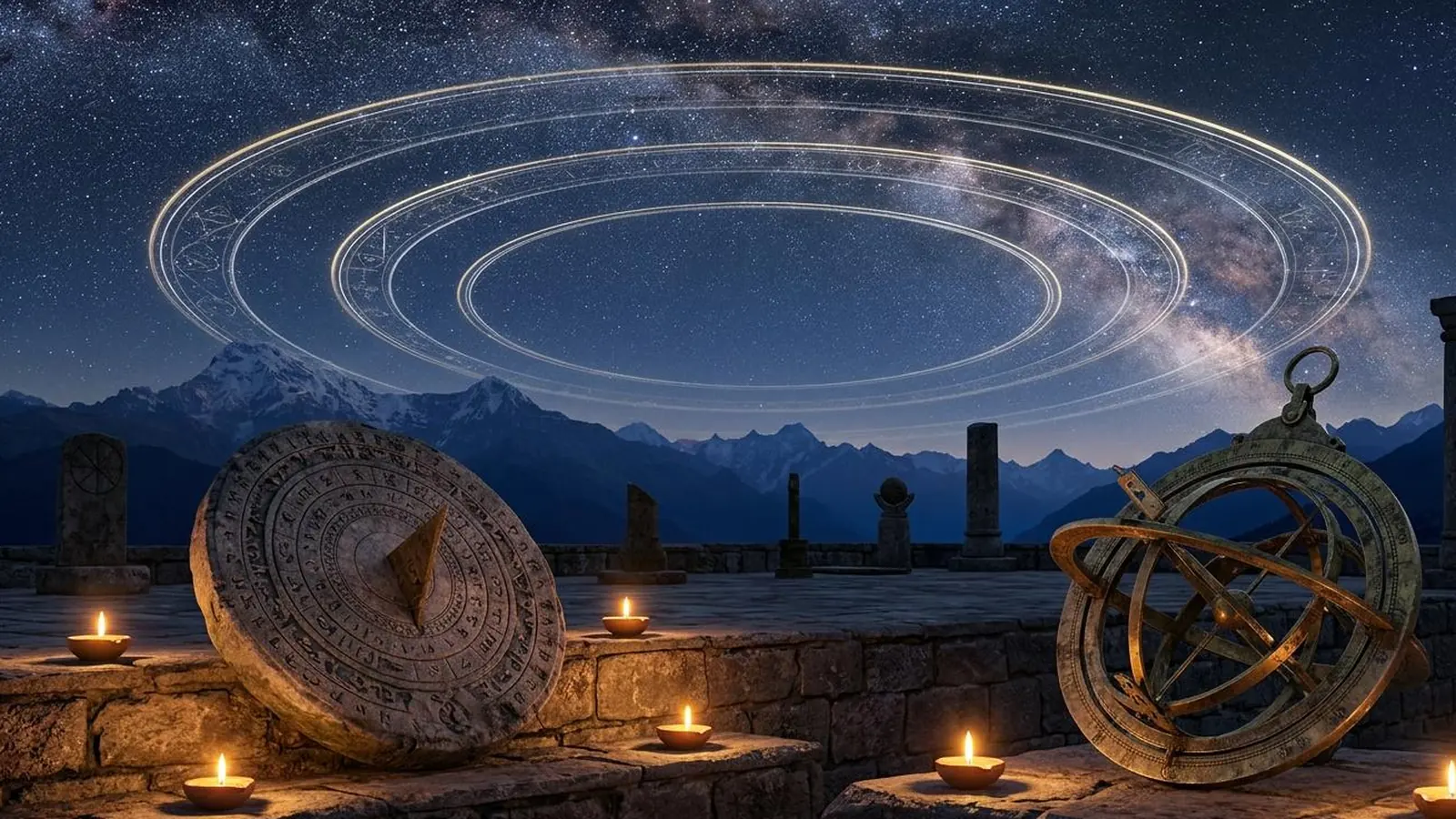
The 4 Yugas—Satya (Krita), Treta, Dvapara, and Kali—form the cornerstone of Vedic cosmology and ancient Indian timekeeping. While many modern cultures once conceived of cosmic history as a brief, linear timeline lasting only a few thousand years, the rishis of Sanatana Dharma measured time across vast, repeating astronomical cycles stretching from human seasons to billions of years.
Far from arbitrary numbers, the fourfold Yuga architecture in the Mahabharata, Manusmriti, Vishnu Purana, and Surya Siddhanta encodes exact mathematical ratios (4:3:2:1), nested planetary cycles, and a profound psychology of human dharma. Even more remarkably, a single Day of Brahma (Kalpa)—1,000 cycles of the four Yugas—equals 4.32 billion human years, matching modern astrophysics’ estimate for the age of the Solar System (~4.5 billion years).
In this comprehensive guide, we examine the primary Sanskrit verse from Bhagavad Gita 8.17, break down the exact calculations of the 4 Yugas and Mahayuga, compare the classical Puranic timeline with the precessional Yuga model, and explore how NASA’s research on Earth’s orbital cycles illuminates the Vedic science of cyclical time.
Primary Sanskrit Shloka & Translation from the Bhagavad Gita
The foundational scriptural statement linking the four Yugas to cosmic deep time appears in Bhagavad Gita 8.17 (echoing Mahabharata Shanti Parva 231.31 and Manusmriti 1.73, as documented in Bhagavad Gita Rahasya), where Lord Krishna explains the Day and Night of Brahma:
Devanagari (Bhagavad Gita 8.17):
सहस्रयुगपर्यन्तमहर्यद्ब्रह्मणो विदुः ।
रात्रिं युगसहस्रान्तां तेऽहोरात्रविदो जनाः ॥ १७ ॥IAST Transliteration:
sahasra-yuga-paryantam ahar yad brahmaṇo viduḥ |
rātriṃ yuga-sahasrāntāṃ te ‘ho-rātra-vido janāḥ || 17 ||
Word-by-Word Breakdown (Bhagavad Gita 8.17):
- Sahasra-yuga-paryantam (सहस्रयुगपर्यन्तम्): Extending to one thousand cycles of the four Yugas (Chaturyuga / Mahayuga).
- Ahaḥ yat brahmaṇaḥ (अहः यत् ब्रह्मणः): That which constitutes one daytime (Kalpa) of Creator Brahma.
- Viduḥ (विदुः): They truly know and understand.
- Rātriṃ yuga-sahasrāntām (रात्रिं युगसहस्रान्ताम्): And His night (cosmic dissolution/rest, Pralaya) lasting another thousand Yuga cycles.
- Te ‘ho-rātra-vidaḥ janāḥ (ते अहोरात्रविदः जनाः): Those sages are the true knowers of cosmic day and night.
The Mathematics of the 4 Yugas: 4:3:2:1 Ratio & Kalpa Deep Time
In classical Jyotisha and Puranic texts (Manusmriti 1.68–73, Vishnu Purana 1.3, and Surya Siddhanta 1.15–17), time is measured on two interlocking scales: human solar years and celestial (Deva) years, where 1 celestial year equals 360 human solar years. A complete four-age cycle—called a Mahayuga or Chaturyuga—spans exactly 12,000 celestial years, or 4,320,000 human years, divided in a descending 4:3:2:1 ratio (with dawn Sandhya and twilight Sandhyansha transitions comprising one-sixth of each age):
- Satya Yuga (Krita Yuga) — 4,800 Celestial Years (1,728,000 Human Years): The Age of Truth and Harmony, symbolized by the bull of Dharma standing firmly on all four legs. Humanity lives in direct intuitive alignment with cosmic order (Rta), truthfulness, and effortless contemplation.
- Treta Yuga — 3,600 Celestial Years (1,296,000 Human Years): The Age of Three-Quarters Dharma (symbolized by three legs of the bull). Ritual sacrifice (Yajna), structured social duty, and disciplined kingdoms emerge—the era associated in Itihasa with Lord Rama and the Ramayana.
- Dvapara Yuga — 2,400 Celestial Years (864,000 Human Years): The Age of Two-Quarters Dharma (two legs of the bull). Analytical intellect, dualistic debate, and scripture codification flourish; Sage Vyasa divides the single Veda into four Samhitas, and Lord Krishna teaches the Bhagavad Gita before the transition marked by Submerged Dwarka.
- Kali Yuga — 1,200 Celestial Years (432,000 Human Years): The Age of One-Quarter Dharma (one leg of the bull). Material complexity, rapid technological change, and spiritual forgetfulness intensify—yet scriptures uniformly affirm that even simple, sincere remembrance of the Divine yields liberation swiftly in Kali Yuga.
Scaling upward from one Mahayuga (4.32 million years): 71 Mahayugas form one Manvantara (the reign of a Manu, ~306.72 million years), and 14 Manvantaras (plus transitional Sandhis) equal 1,000 Mahayugas = 1 Kalpa = 4.32 billion human years—one daytime of Brahma, paired with a 4.32-billion-year cosmic night, echoing the grand cosmic hierarchy explored in our guide to the 14 Lokas in Vedic Cosmology.
Puranic Deep Time vs. the Precessional Yuga Model
Seekers studying the 4 Yugas often encounter two distinct, complementary calculation traditions in Indian thought:
- The Classical Siddhantic & Puranic Model (4,320,000 Years): Used by traditional Panchangs, Surya Siddhanta, and classical Puranas, this model multiplies the 12,000-year cycle by 360 to convert celestial years into human years. Under this reckoning, the current Kali Yuga began around 3102 BCE following Lord Krishna’s departure, meaning we are just over 5,100 years into a 432,000-year age.
- The Equinoctial / Precessional Model (24,000 Years): Proposed in 1894 by Swami Sri Yukteswar Giri in The Holy Science, this interpretation treats the 12,000 years as literal solar years for one descending arc (Satya → Treta → Dvapara → Kali) followed by an ascending 12,000-year arc (Kali → Dvapara → Treta → Satya)—totaling 24,000 years, closely mirroring Earth’s astronomical axial precession cycle.
Rather than dismissing one for the other, many scholars note that Vedic cosmology excels at fractal, multi-scale timekeeping—where smaller human-civilizational cycles nest inside vast geological and cosmic epochs.
Astronomical Foundations in the Surya Siddhanta & Aryabhatiya
Modern readers often wonder why ancient Indian astronomers arrived at such colossal figures as 4,320,000 years for a single Mahayuga. Far from mystical guesswork, ancient texts such as the Surya Siddhanta (chapters 1–2) and Aryabhata’s landmark treatise Aryabhatiya (Gitikapada 3–5) treat the Mahayuga as a rigorous astronomical epoch—specifically, the least common multiple (LCM) of the mean orbital periods of all seven classical visible celestial bodies: the Sun, Moon, Mercury, Venus, Mars, Jupiter, and Saturn.
According to ancient Indian computational astronomy, at the precise moment a Mahayuga begins, all planetary orbits theoretically align in a celestial grand conjunction at 0° Aries (the first point of the sidereal zodiac, known in Sanskrit as Mesha Adi). Over the course of 4,320,000 human solar years, each planet completes an exact integer number of revolutions around the zodiac:
- The Sun: Completes exactly 4,320,000 sidereal revolutions.
- The Moon: Completes 57,753,336 sidereal lunar revolutions.
- Mars: Completes 2,296,832 revolutions across the Mahayuga.
- Mercury (Budha): Completes 17,937,060 revolutions in its heliocentric cycle.
- Jupiter (Brihaspati): Completes 364,220 slow sidereal revolutions (~11.86 years per cycle).
- Venus (Shukra): Completes 7,022,376 revolutions.
- Saturn (Shani): Completes 146,568 orbital revolutions (~29.46 years per cycle).
Furthermore, ancient astronomers used this exact mathematical harmonic to fix the historical start date of the current Kali Yuga. In the Aryabhatiya (Kalakriyapada 10), Aryabhata noted that he was 23 years old when 3,600 years of Kali Yuga had elapsed, pinpointing his own writing to the year 499 CE. Back-calculating from that epoch yields the widely accepted traditional date for the beginning of Kali Yuga: midnight on the Ujjain meridian between February 17 and February 18, 3102 BCE, coinciding with the departure of Lord Krishna and the planetary alignment recorded in the Mahabharata astronomical traditions.
The Four Pillars of Dharma Across the Yugas & Prescribed Yuga-Dharma
Beyond mathematical and astronomical dimensions, the 4 Yugas encode an allegorical psychology of collective consciousness. In the Srimad Bhagavatam (Canto 1, Chapter 17, verses 24–25) and the Manusmriti (1.81–86), Dharma is traditionally depicted as a majestic sacred bull (Vṛṣa) standing upon four golden pillars:
- Satya (Truthfulness & Integrity): Absolute alignment of thought, speech, and action with reality.
- Tapas (Austerity & Self-Discipline): Mastery over senses, endurance of dualities, and dedicated contemplation.
- Śauca (Purity & Cleanliness): Outer physical hygiene and inner mental clarity free from delusion.
- Dayā (Compassion & Non-Violence): Active benevolence, empathy for all living beings, and protection of the vulnerable.
With each passing Yuga, humanity’s collective adherence to cosmic order weakens under the weight of egotism and material infatuation, causing one of the bull’s legs to collapse:
- Satya Yuga (4 Legs Intact): Truth, Austerity, Purity, and Compassion operate at their peak. The recommended path (Yuga-Dharma) is deep silent meditation (Dhyana) and contemplative union with the Supreme.
- Treta Yuga (3 Legs Remaining): Austerity (Tapas) begins to erode due to desire for personal rewards. The prescribed Yuga-Dharma shifts to sacred rituals, knowledge-seeking, and elaborate fire sacrifices (Yajna).
- Dvapara Yuga (2 Legs Remaining): Purity (Śauca) weakens amidst ambition and rivalry. The prescribed spiritual discipline transitions to consecrated temple worship, deity service, and structured liturgy (Archana).
- Kali Yuga (1 Leg Remaining): Only Truthfulness (Satya) barely survives as a single trembling leg amidst pervasive deception and distraction. Because human lifespan is short and mental focus easily scattered, the Brihad-Naradiya Purana and Bhagavata Purana declare that the ultimate Yuga-Dharma for Kali Yuga is the effortless chanting and remembrance of divine names (Nama-Sankirtana).
Scientific Parallels: Solar System Age, Milankovitch Cycles & Deep Time
Viewed alongside modern astrophysics and Earth science, the Vedic Yuga system stands out as an astonishingly sophisticated intuition of cosmic deep time and orbital periodicity:
- The 4.32 Billion-Year Kalpa & Solar System Age: According to NASA Science, our Solar System and planets formed roughly 4.5 billion years ago—placing the classical Vedic Kalpa of 4.32 billion years on the exact same order of magnitude as modern radiometric dating of Earth and meteorites, thousands of years before modern geology discovered deep time.
- Milankovitch Orbital & Precessional Cycles: As detailed by NASA’s Earth Science research on Milankovitch cycles, Earth’s climate and seasonal solar exposure are governed by three nested astronomical rhythms: orbital eccentricity (~100,000 years), axial obliquity/tilt (~41,000 years), and combined axial-apsidal precession (~23,000–25,772 years). These real celestial cycles drive recurring ice ages and warm interglacials—mirroring the Vedic view that planetary conditions evolve cyclically rather than linearly.
- Pulsating / Cyclical Cosmology: Modern theoretical models of cyclic or bouncing universes (where cosmic expansion and contraction repeat across aeons) resonate strongly with Bhagavad Gita 8.17–19, which describes manifestation emerging at Brahma’s dawn and dissolving back into unmanifest potential at cosmic night, much like the cosmic origin described in the Hiranyagarbha Sukta.
4 Yugas Comparison Table: Durations, Ratios & Characteristics
| Yuga Name | Ratio | Celestial Years (Deva) | Human Solar Years (Classical) | Dharma Quotient | Defining Spiritual & Civilizational Focus |
|---|---|---|---|---|---|
| Satya (Krita) Yuga | 4 | 4,800 | 1,728,000 | 100% (4/4) | Direct realization, contemplation (Dhyana), effortless harmony |
| Treta Yuga | 3 | 3,600 | 1,296,000 | 75% (3/4) | Sacred ritual (Yajna), noble kingship, disciplined duty |
| Dvapara Yuga | 2 | 2,400 | 864,000 | 50% (2/4) | Scriptural codification, temple worship, philosophical inquiry |
| Kali Yuga | 1 | 1,200 | 432,000 | 25% (1/4) | Material complexity; rapid inner liberation through devotion & Nama-smarana |
| 1 Mahayuga (Total) | 10 | 12,000 | 4,320,000 | Full Cycle | One complete four-age rotation; 1,000 Mahayugas = 1 Kalpa (4.32B yrs) |
Common Misconceptions About the 4 Yugas
- Misconception: Kali Yuga means hopeless doom. Classical texts like the Srimad Bhagavatam (12.3.51–52) and Vishnu Purana actually praise Kali Yuga for one extraordinary advantage: what required decades of severe austerity in Satya Yuga can be attained through sincere devotion, truthfulness, and inner mindfulness in Kali Yuga.
- Misconception: Time is strictly fatalistic in Vedic philosophy. While macro-cosmic cycles unfold at planetary scale, individual consciousness is never trapped by the calendar; as Yoga and Vedanta teach, a seeker can live in “Satya Yuga awareness” right inside Kali Yuga.
- Misconception: The 4 Yugas are purely literary invention. Ancient Indian astronomers in the Surya Siddhanta and Aryabhata’s Aryabhatiya used the Mahayuga framework as a computational least-common-multiple epoch for planetary conjunctions and eclipse predictions.
Practical Takeaway: Living in Your Inner “Satya Yuga”
The Aitareya Brahmana (7.15) famously compares the four Yugas to states of human effort: sleeping is Kali, waking up is Dvapara, standing ready is Treta, and walking forward in purposeful action (Charaiveti, Charaiveti) is Satya Yuga. Regardless of which cosmic epoch our calendars record, every morning offers the choice to step out of inertia, cultivate clarity, and live by truth.
Read More on InVedas
- 14 Lokas in Vedic Cosmology: Meaning, Hierarchy & Modern Science
- Submerged Dwarka: Mahabharata History, CSIR-NIO Marine Archaeology & Coastal Science
- 33 Koti Devtas Explained: The Vedic Science of 33 Cosmic Principles
- Hiranyagarbha Sukta (Rigveda 10.121): Meaning & Creation Hymn
Frequently Asked Questions on the 4 Yugas
What are the 4 Yugas in Hinduism?
The 4 Yugas (Chaturyuga) are four repeating cosmic ages in Vedic cosmology: Satya (Krita) Yuga, Treta Yuga, Dvapara Yuga, and Kali Yuga, spanning a 4:3:2:1 ratio of duration and dharma.
How long is each of the 4 Yugas in human years?
According to the classical Manusmriti and Surya Siddhanta calculation, Satya Yuga lasts 1,728,000 years, Treta Yuga lasts 1,296,000 years, Dvapara Yuga lasts 864,000 years, and Kali Yuga lasts 432,000 years—totaling 4,320,000 years per Mahayuga.
How does a Kalpa compare to the scientific age of Earth?
As stated in Bhagavad Gita 8.17, one Day of Brahma (1 Kalpa) equals 1,000 Mahayugas, or 4.32 billion human years—remarkably close to NASA’s scientific estimate of ~4.5 billion years for the formation of Earth and the Solar System.
Which Yuga are we living in right now?
According to traditional Indian Panchangs and astronomical treatises, humanity is currently in the early millennia of Kali Yuga, which began around 3102 BCE following the Mahabharata era.
What is the difference between Puranic Yugas and Sri Yukteswar’s Yuga cycle?
The classical Puranic model multiplies 12,000 celestial years by 360 to yield 4,320,000 human years per Mahayuga, whereas Sri Yukteswar’s 1894 model interprets the 12,000 years as solar years across ascending and descending arcs (24,000 years total), paralleling Earth’s axial precession cycle.
Closing Reflection
The 4 Yugas expand our imagination beyond narrow, linear timelines into a universe of rhythmic renewal and deep astronomical order. By understanding both the vastness of cosmic time and the immediacy of moral choice in the present moment, we inherit one of Sanatana Dharma’s highest insights: every era is an invitation to awaken.
For an expansive exploration of India’s cultural tapestry, sacred geographies, and living traditions, explore Pardeep’s definitive work: Many Faces of India.