Submerged Dwarka—the legendary golden coastal capital of Lord Krishna that slipped beneath the waves of the Arabian Sea—has captivated seekers, historians, and oceanographers for millennia. Described vividly in the Mahabharata, Harivamsha, and Puranas as a fortified maritime city-state on the western coast of Gujarat, Dwarka was long dismissed by colonial-era commentators as pure allegory.
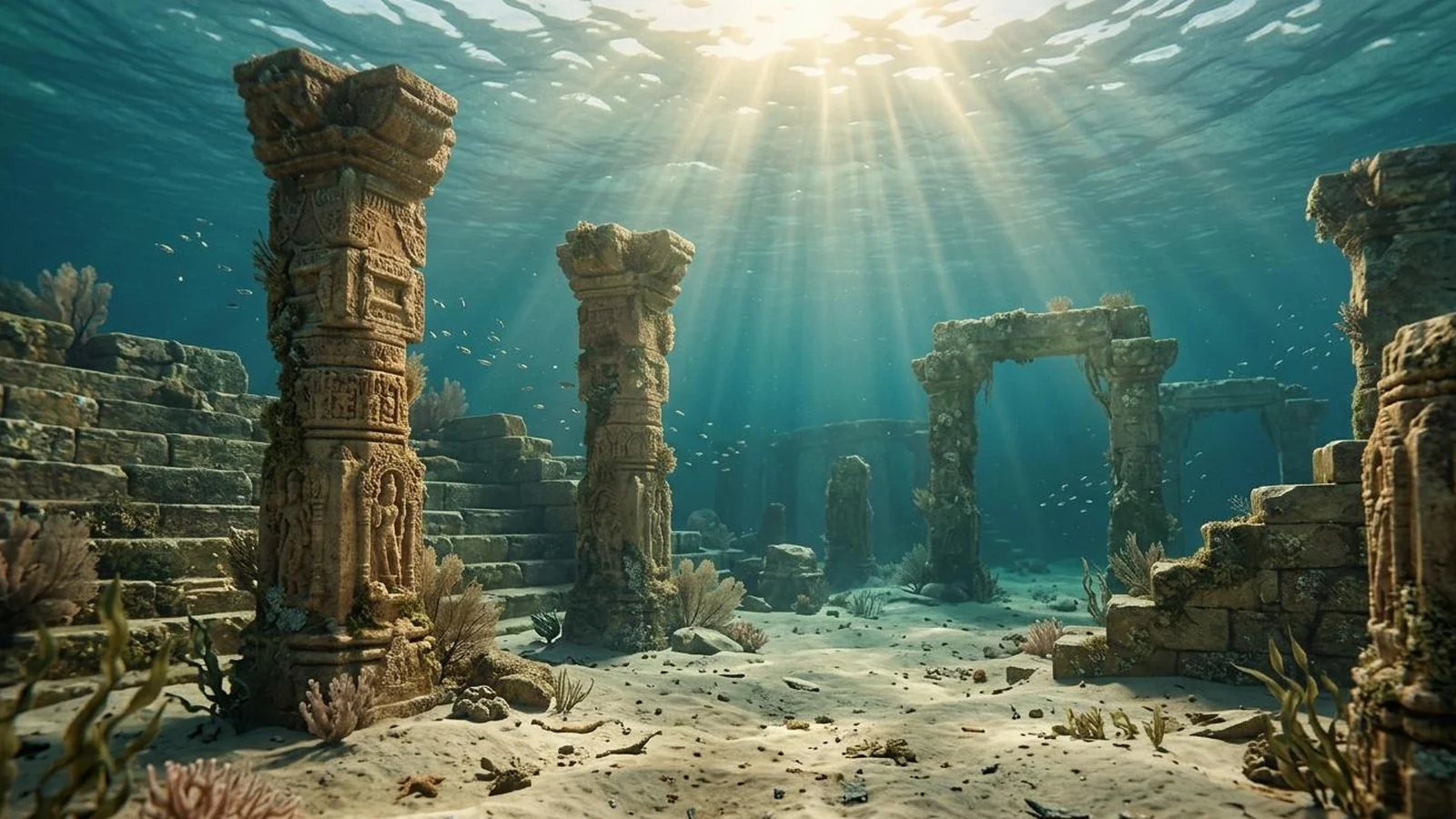
That skepticism began to shift dramatically in the late twentieth century when India’s Archaeological Survey of India (ASI) and the Marine Archaeology Centre at CSIR–National Institute of Oceanography (NIO), Goa, launched systematic underwater expeditions off modern Dwarka and the nearby island of Bet Dwarka. Divers documented dressed stone masonry, submerged bastion-like alignments, dozens of heavy stone anchors, and Bronze Age coastal artifacts resting on the seabed.
In this comprehensive guide, we examine the exact Sanskrit tradition and scriptural accounts of Dwarka’s founding and submergence in the Mahabharata, review the peer-reviewed marine archaeology findings from CSIR–NIO, explore the coastal geology of Holocene sea-level fluctuations along the Saurashtra coast, and reflect on why Dwarka remains one of India’s seven sacred Moksha-puris.
Table of Contents
Primary Sanskrit Shloka & Scriptural Context
To understand the spiritual meaning of Lord Krishna’s earthly mission—from establishing Dwarka (Dvaravati, “the city of many gates”) to concluding His lila at Prabhasa—Sanatana Dharma anchors His presence in the timeless promise of the Bhagavad Gita (4.7), explored further in our Bhagavad Gita Verses guide:
Devanagari (Bhagavad Gita 4.7):
यदा यदा हि धर्मस्य ग्लानिर्भवति भारत ।
अभ्युत्थानमधर्मस्य तदात्मानं सृजाम्यहम् ॥ ७ ॥IAST Transliteration:
yadā yadā hi dharmasya glānir bhavati bhārata |
abhyutthānam adharmasya tadātmānaṃ sṛjāmy aham || 7 ||
|—|—|—|—|/wp:quote –>
Word-by-Word Breakdown (Bhagavad Gita 4.7):
- Yadā yadā hi (यदा यदा हि): Whenever and wherever indeed.
- Dharmasya glāniḥ bhavati (धर्मस्य ग्लानिर्भवति): There occurs a decline or weakening of cosmic and ethical order (Dharma).
- Bhārata (भारत): O descendant of Bharata (addressing Arjuna).
- Abhyutthānam adharmasya (अभ्युत्थानम् अधर्मस्य): And a predominant uprising of unrighteousness (Adharma).
- Tadā ātmānam sṛjāmy aham (तदात्मानं सृजाम्यहम्): At that time, I manifest Myself through My own divine potency.
In the sixteenth book of the Mahabharata—the Mausala Parva (Section 7)—once that cosmic purpose is fulfilled thirty-six years after the Kurukshetra War, Krishna departs the mortal world at Prabhasa. Arjuna arrives to evacuate the remaining Vrishni elders, women, and children—escorting them toward Indraprastha (where Vajra is installed) and the banks of the River Sarasvati—just as the Arabian Sea surges inward, swallowing the glittering avenues and fortifications of Dwarka.
Scriptural Blueprint: How Dwarka Was Built & Submerged
According to the Mahabharata (Sabha Parva) and Harivamsha, Krishna relocated the Yadava clan from Mathura to the western Saurashtra coast to protect them from repeated sieges by Jarasandha. Reclaiming twelve yojanas of coastal land from the sea, the celestial architect Vishwakarma designed Dvaravati as a fortified island-port surrounded by deep moats, broad symmetrical avenues, and towering defensive gates—applying classical urban geometry reminiscent of the Vastu Purusha Mandala.
The Mausala Parva recounts the final hours with sobering precision: ominous coastal tides, birds falling silent, and the ocean breaking its natural boundary. As the last residents crossed beyond the city gates, the sea surged through the streets and covered the buildings one by one until the waters grew calm again, leaving Dwarka’s name etched in living memory.
CSIR–NIO Marine Archaeology: What Lies Beneath Dwarka Waters
Modern scientific investigation of Submerged Dwarka began with onshore excavations by the Archaeological Survey of India in 1963 and expanded underwater in the 1980s when Dr. S. R. Rao established the Marine Archaeology Centre at CSIR–National Institute of Oceanography (NIO), Goa, later continued extensively by Dr. A. S. Gaur and Sundaresh.
- Submerged Stone Structures & Fortified Alignments: Diving operations in depths ranging from the intertidal zone down to 6–12 meters off Gomati Creek and Dwarka revealed dressed sandstone and limestone blocks, semicircular and rectangular structural bases, and wall alignments documented in peer-reviewed reports such as Current Science (Vol. 86, No. 9, 2004).
- Stone Anchors & Maritime Trade: One of the most remarkable discoveries in Dwarka waters is the sheer density of ancient stone anchors—including triangular three-hole composite anchors, Indo-Arabian grapnel anchors, and ring-stone anchors—proving that the submerged seabed served as a major Indian Ocean harbor connecting Gujarat with the Persian Gulf and Red Sea.
- Bet Dwarka Late Harappan Finds: Just north of mainland Dwarka, excavations at Bet Dwarka Island uncovered Late Harappan pottery (lustrous red ware, perforated jars), a large Bronze Age copper fishhook, shell artifacts, and later Roman amphorae sherds and lead anchors, demonstrating continuous maritime occupation spanning from the second millennium BCE through the early historical period.
Coastal Geology: Sea-Level Rise, Tectonics & Chronology
To understand how a thriving port city ends up underwater, oceanographers look at two well-documented natural mechanisms along the Gujarat coastline:
- Holocene Marine Transgressions & Coastal Subsidence: The Gulf of Kachchh and Saurashtra coast experience some of the highest tidal ranges in India alongside active tectonic fault zones (as evidenced by the 1819 Allah Bund and 2001 Bhuj earthquakes). Minor crustal subsidence combined with post-glacial sea-level fluctuations can submerge coastal jetties and low-lying port districts over centuries.
- Multi-Phase Chronological Debate: While Dr. S. R. Rao proposed that a 1500 BCE submergence event corresponded to the Mahabharata’s Dwarka, subsequent NIO studies led by A. S. Gaur note that many of the visible shallow-water stone anchors and harbour structures near modern Dwarka date from the early historical to medieval periods, whereas Bet Dwarka preserves clear Late Harappan (second millennium BCE) strata. Both perspectives agree on one foundational truth: Dwarka was a real, ancient, multi-layered maritime hub shaped by sea-level change.
Inner & Outer Correspondence: Dvaravati as the City of Nine Gates
In Vedanta and Yoga, sacred geography always carries an inner psychological parallel. The name Dwarka (Dvaravati) literally means “possessing many gates.” In the Bhagavad Gita (5.13) and Shvetashvatara Upanishad (3.18), the human body itself is called Navadvare Pure—”the city of nine gates” (two eyes, two ears, two nostrils, mouth, and two lower apertures) in which the indwelling Self (Purusha) resides.
Just as physical Dwarka stood as a radiant fortress beside the restless ocean, our embodied awareness stands amidst the ever-changing tides of sensory experience. And when the outer structures of ego and empire inevitably dissolve into the ocean of time—just as Arjuna witnessed in the Mausala Parva—only the changeless inner Self remains.
Submerged Dwarka Comparison Table: Scripture vs. Marine Archaeology
| Dimension | Mahabharata & Puranic Record | CSIR–NIO & ASI Archaeological Findings | Synthesis & Insight |
|---|---|---|---|
| Location | Fortified island-port on Saurashtra coast (Okhamandal / Dvaravati) | Offshore Gomati Creek (Dwarka) & Bet Dwarka Island, Gujarat | Exact geographic continuity on the Gulf of Kachchh mouth |
| Architecture & Harbor | Gateways, broad avenues, protective sea walls, maritime trade | Dressed limestone blocks, semicircular/rectangular bases, jetty walls | Confirms planned coastal stone construction & port infrastructure |
| Maritime Activity | Prosperous coastal capital connected to wider kingdoms | Composite, triangular & grapnel stone anchors; Roman amphorae; shell seals | Proves major Indian Ocean & Persian Gulf trade hub |
| Dating & Phases | End of Dvapara Yuga (post-Kurukshetra transition) | Bet Dwarka Late Harappan (~1500 BCE) + Dwarka historical/medieval phases | Multi-period coastal settlement shaped by repeated sea shifts |
| Cause of Submergence | Sudden inward surge of the ocean after Krishna’s departure | Coastal subsidence, tectonic seismicity & Holocene sea-level changes | Physical coastal dynamics match enduring literary memory |
Common Misconceptions About Submerged Dwarka
- Misconception: Dwarka is pure legend with no physical evidence. Decades of peer-reviewed marine surveys by CSIR–NIO and the ASI have mapped real submerged stone structures, harbour anchors, and Late Harappan artifacts at Dwarka and Bet Dwarka.
- Misconception: Every underwater stone block dates to a single 10,000-year-old city. Careful stratigraphy and anchor typology show multiple occupational layers—from Late Harappan (~1500 BCE) at Bet Dwarka through early historical and medieval port phases—rather than one uniform stratum.
- Misconception: Submergence erased Dwarka’s spiritual continuity. Today’s Dwarkadhish Temple stands directly on the shore above the ancient coastal channels, preserving Dwarka’s unbroken status as one of Hinduism’s four Char Dham pilgrimage sites and seven Sapta Puri liberation cities.
Practical Takeaway: Anchoring in What Cannot Be Submerged
The story of Submerged Dwarka offers a grounded, timeless reflection: even the mightiest golden city eventually yields to the tides of time (Kala). Rather than clinging anxiously to outer achievements, Sanatana Dharma encourages us to build our inner life on eternal values—duty without attachment, truthfulness, and steady awareness of the Divine within.
Read More on InVedas
- River Sarasvati: Rigveda History, ISRO Paleochannel Science & Sacred Legacy
- Bhagavad Gita Verses: Most Searched Shlokas 4.7, 2.47 & 11.32 Explained
- Who Were the Samsaptakas in Mahabharata? The Suicide Squad Vowed to Slay Arjuna
- Vastu Purusha Mandala: Sacred Geometry in Classical Shilpa Shastra
Frequently Asked Questions on Submerged Dwarka
Have underwater ruins of Submerged Dwarka actually been found?
Yes. Beginning in the 1980s, marine archaeologists from CSIR–National Institute of Oceanography (NIO) and the Archaeological Survey of India (ASI) documented submerged stone walls, dressed sandstone blocks, circular structural bases, and dozens of ancient stone anchors off Dwarka and Bet Dwarka in Gujarat.
Why did Dwarka submerge according to the Mahabharata?
In the Mausala Parva (Book 16 of the Mahabharata), Dwarka submerged beneath the Arabian Sea shortly after Lord Krishna departed the mortal world and Arjuna evacuated the surviving Vrishni residents toward Indraprastha and the Sarasvati basin.
How old are the archaeological finds at Dwarka and Bet Dwarka?
Excavations at Bet Dwarka have yielded Late Harappan pottery and a Bronze Age copper fishhook dating to roughly the second millennium BCE (~1500 BCE), while offshore Dwarka structures and stone anchors span early historical through medieval maritime phases.
What do the stone anchors found off Dwarka prove?
The variety and abundance of triangular three-hole composite anchors, ring-stone anchors, and Indo-Arabian grapnel anchors prove that ancient Dwarka functioned as a major international harbor on Indian Ocean trade routes.
What geological factors explain Dwarka’s submergence?
Geologists attribute coastal submergence along the Saurashtra and Gulf of Kachchh coastline to a combination of tectonic subsidence, coastal erosion, and Holocene sea-level fluctuations.
Closing Reflection
Submerged Dwarka stands as a remarkable testament to the harmony between Vedic memory and modern marine science. Beneath the waves of the Arabian Sea, stone anchors and ancient harbour walls quietly confirm India’s millennia-old maritime heritage—inviting us to look both outward at our living history and inward toward the timeless truth of the Bhagavad Gita.
For an expansive exploration of India’s cultural tapestry, sacred geographies, and living traditions, explore Pardeep’s definitive work: Many Faces of India.