
Understanding who were samsaptakas in mahabharata unveils one of the most intense, disciplined, and terrifying dimensions of ancient Vedic warfare recorded in the Mahabharata. While the epic is celebrated for legendary individual duels between stalwarts like Bhishma, Drona, Karna, and Arjuna, the Samsaptakas represent a rare and formidable tactical phenomenon: a specialized suicide squad of tens of thousands of elite warriors bound by an irrevocable sacred oath sworn before sacrificial fire, dedicating their mortal lives solely to either killing the greatest archer of the age or dying upon the battlefield of Kurukshetra.
Far from being an ordinary military unit, the Samsaptakas were forged out of political desperation and martial devotion under the leadership of King Susharma of Trigarta. As the great Kurukshetra War dragged past its tenth day and the venerable grandsire Bhishma fell upon the bed of arrows, the Kaurava high command recognized an insurmountable reality: so long as Arjuna remained free to maneuver across the field, the Pandava army could never be routed. To neutralize this supreme warrior, Dronacharya devised a strategic plan that required a force willing to sacrifice every last soldier to draw Arjuna far away into the southern sector of the battlefield, thereby creating the deadly tactical vacuum that precipitated the fatal formation of the Chakravyuha.
In this authoritative, scripture-backed guide, we examine the historical origins of the Trigarta dynasty, the profound Vedic rituals through which the Samsaptaka oath was consecrated, the exact battle maneuvers of the 12th, 13th, 14th, and 17th days of the war, and how Bhagavan Sri Krishna guided Arjuna through storm after storm of celestial weapons. Drawing directly from the Drona Parva and Karna Parva, this deep dive reveals the forgotten tactical mechanics of ancient India’s most fearsome warrior brotherhood.
Table of Contents
Etymology and Meaning: What Does the Word “Samsaptaka” Signify?
To comprehend who were samsaptakas in mahabharata, one must first dissect the Sanskrit roots of this sacred and chilling designation. The term Samsaptaka (संशप्तक) is derived from the verbal root śap (शप्), meaning “to curse, to swear an oath, or to make a binding vow,” combined with the intensive prefix sam (सम्), signifying “thoroughly, collectively, and irrevocably.”
In classical Sanskrit martial terminology, a Samsaptaka is defined as:
संशप्तक (Samsaptaka): “One who has sworn a solemn oath together with comrades before a consecrated fire, taking a mutual vow never to turn back from combat alive until their designated mission is accomplished.”
Unlike regular soldiers who fought under sovereign command and retained the conventional right to withdraw when formations broke or twilight fell, the Samsaptakas consciously renounced survival. They entered the fray as *Atmatyagi* warriors—individuals who had performed their own pre-mortem funeral rites, severing their earthly attachments to wives, children, dynasties, and kingdoms. They were legally, spiritually, and psychologically dead the moment they stepped across the sacrificial perimeter.
The Sacred Sanskrit Shloka: The Terrifying Vow of the Samsaptakas
The Mahabharata (specifically within the Samsaptakabadha Parva of the Drona Parva) preserves the exact text of the horrifying covenant sworn by King Susharma, his brothers, and his vast division of elite charioteers and cavalry:
संशप्तकास्तु समरे द्रोणेन विहिता युधि ।
अर्जुनस्य वधप्रेप्सोर्निवृत्ताश्चैव भारत ॥Saṃśaptakāstu samare droṇena vihitā yudhi ।
Arjunasya vadhaprepsornivṛttāścaiva bhārata ॥— Mahabharata, Drona Parva (Samsaptakabadha Parva), Chapter 17
Word-by-Word Translation & Analysis:
- Saṃśaptakāḥ (संशप्तकाः): The warriors who had taken the solemn oath of death.
- Tu (तु): Indeed / verily.
- Samare (समरे): In the great battle of Kurukshetra.
- Droṇena (द्रोणेन): By preceptor Dronacharya.
- Vihitāḥ (विहिताः): Formed, marshaled, and assigned their operational objective.
- Yudhi (युधि): In warfare.
- Arjunasya (अर्जुनस्य): Of Dhananjaya Arjuna, son of Kunti.
- Vadhaprepsoḥ (वधप्रेप्सोः): With the single-minded burning desire to slay him.
- Nivṛttāḥ (निवृत्ताः): Turning their backs or retreating.
- Ca (च) Eva (एव): Under no circumstances whatsoever.
- Bhārata (भारत): O descendant of Bharata (King Dhritarashtra).
This verse crystallizes the sole objective of this division: to stand as an unbreakable wall against Arjuna, neither breaking under the weight of divine celestial missiles nor fleeing even when their ranks were reduced to ashes.
The Ritual of Agni Sakshi: How the Death Oath Was Consecrated
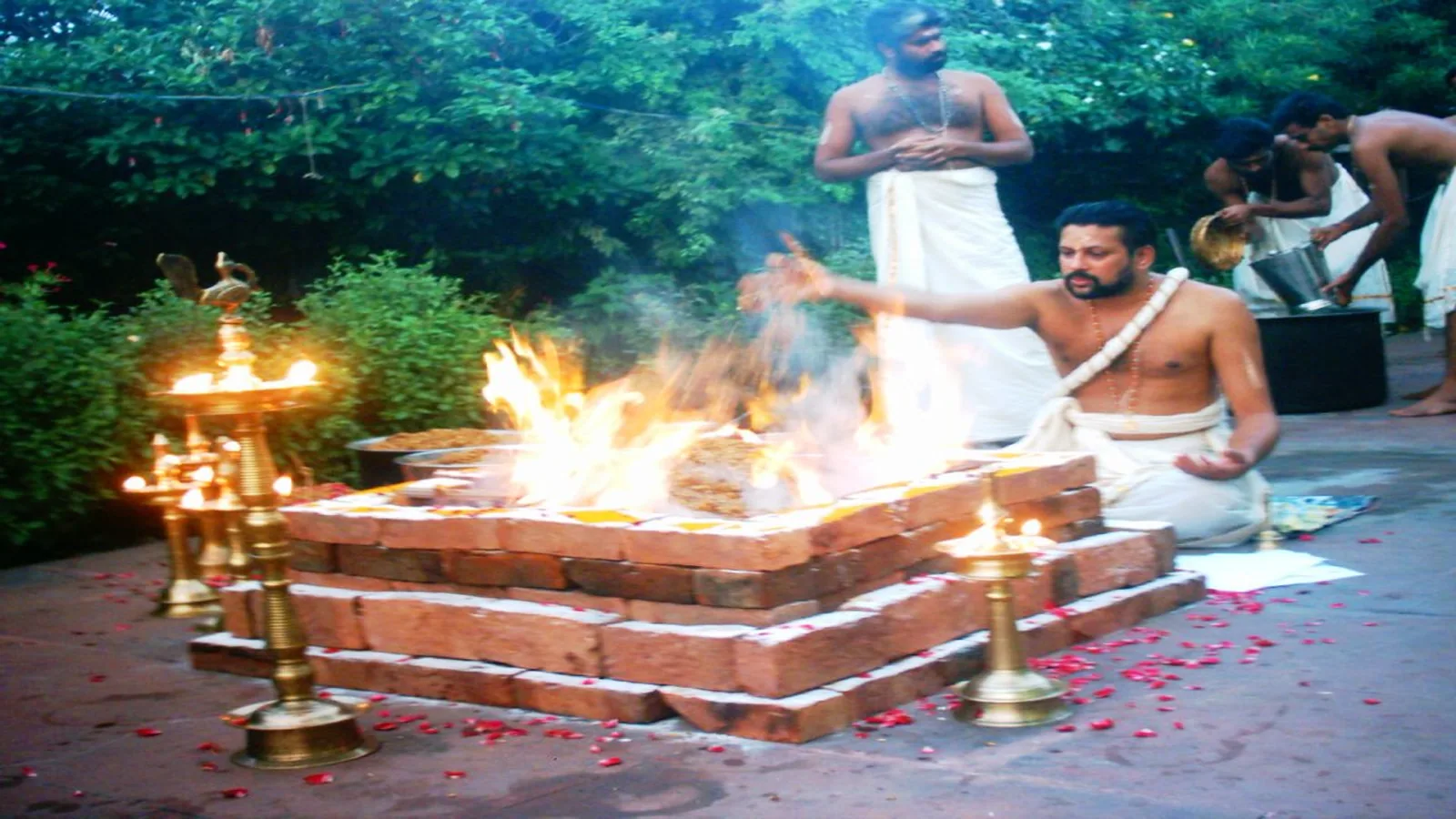
In Vedic civilization, an oath was not an abstract verbal agreement; it was an ontological bond forged in the presence of Agni, the cosmic witness (*Agni Sakshi*), who consumes oblations and records the truth of every soul. The ritual through which the Samsaptakas bound themselves is one of the most intense ceremonies described in the epic literature.
Before dawn on the eleventh night of the Kurukshetra conflict, King Susharma convened tens of thousands of his veteran warriors in the rear camps of the Kauravas. A massive sacrificial fire altar (*Yajna Kunda*) was erected using sacred *Kusha* (darbha) grass. Ghee, clarified butter, and special aromatic woods were offered into the flames while royal priests chanted solemn hymns from the Yajurveda and Atharvaveda.
Each warrior performed the following sacred rites:
- Tarpanam for Their Own Souls: They poured water oblations, typically performed by living sons for deceased ancestors, effectively pronouncing their own earthly existence terminated.
- Touching the Sacred Fire: Each soldier touched the flaming embers and swore: “If we turn our faces away from Arjuna in terror, if we desert our brothers in the field, if we fail to strike him with all our strength, may all the merits of our sacrifices, our charities, our vows, and our good deeds be completely nullified. May we wander in the darkest hells reserved for the slayers of cows and preceptors.”
- The Ingestion of Sacred Ashes: Marking their foreheads with the sacred bhasma of the fire, they donned clean armor, garlanded themselves with white funeral flowers, and mounted their chariots, steeds, and war elephants as men already walking through the halls of Yama.
King Susharma and the Trigarta Kingdom: Roots of an Ancient Blood Feud
The core leadership of the Samsaptakas hailed from the kingdom of Trigarta, an ancient realm located in the foothills of the Himalayas, corresponding to modern-day Kangra and Jalandhar in Himachal Pradesh and Punjab. To understand why Susharma was so eager to lead a suicide pact against Arjuna, one must look at the deep-seated grievances between Trigarta and the house of Pandu.
Throughout their reigns, the kings of Trigarta had suffered repeated humiliations at the hands of the Pandavas:
- The Digvijaya Yatra: During the great military conquest of the four directions prior to the Rajasuya Yajna, Arjuna marched into the northern regions and soundly subdued the Trigarta kingdom, exacting heavy tributes and asserting Pandava supremacy over their ancient hill forts.
- The Virata Parva Cattle Raid: In the thirteenth year of the Pandavas’ exile, when they were hiding in disguise in the Matsya kingdom of King Virata, Susharma formed a secret alliance with Duryodhana. Trigarta forces launched a surprise attack to steal King Virata’s massive cattle herds from the south. However, Bhima and Yudhishthira arrived on the scene, demolished Susharma’s vanguard, and Bhima captured Susharma alive, holding a blade to his throat and forcing him to publicly declare himself a servant of the Pandavas before releasing him in disgrace.
- The Battle with the Unseen Hero: When Duryodhana’s army raided the northern cattle herds of Virata, Arjuna—disguised as the eunuch charioteer Brihannala—confronted the entire Kaurava leadership alone, unleashing the *Sammohana Astra* to put the whole royal host to sleep, recovering the royal garments and heaping ultimate shame on Susharma’s allies.
These accumulated humiliations burned deeply within the pride of the Trigarta princes. For Susharma and his brothers—Satyamitra, Satyavrata, Satyasena, and Satyadharma—the Kurukshetra War was not a mere dispute over territorial sovereignty; it was a sacred vendetta that could only be washed clean in the blood of Arjuna or the honorable death of their entire lineage.
Dronacharya’s Master Plan: Why the Samsaptakas Were Crucial to the Chakravyuha
On the evening of the twelfth day, after Dronacharya had assumed supreme command of the Kaurava army, Duryodhana approached him with bitter words. Duryodhana accused the venerable Brahmin preceptor of harboring secret affection for the Pandavas, demanding to know why King Yudhishthira had not yet been captured.
Drona replied with absolute tactical candor:
“So long as Arjuna protects Yudhishthira, the lord of heaven himself with all the celestial hosts cannot seize him. There is no warrior on earth, nor in the heavens, who can overpower Dhananjaya while he holds the Gandiva bow. If you can contrive a scheme to lure Arjuna away to a distant sector of the field, I shall weave a formation that none among the remaining Pandavas can pierce, and Yudhishthira shall be captured within the hour.”
Hearing this, King Susharma rose up and stepped forward. He understood that challenging Arjuna to single combat was military suicide, but challenging him *collectively* with an immovable legion would compel Arjuna to honor the Kshatriya code. Under the strict laws of ancient Indian chivalry, a warrior who was challenged to combat by name could never refuse or turn away without suffering eternal ignominy.
Thus, the Samsaptakas deployed themselves far to the southern flank, leagues away from the central Pandava vanguard. With blaring conchs, beating drums, and taunting roars, Susharma cried out across the plains, daring Arjuna to face the Trigarta brotherhood. Arjuna, honoring the sacred duty of a warrior, turned to King Yudhishthira and Bhagavan Krishna, saying: “King Susharma of Trigarta calls me to battle with his brothers. Even if death himself stood before me, I cannot refuse a direct challenge. Permit me, O King, to march south and eradicate this sworn multitude.”
This tactical maneuver succeeded in its primary objective: it dragged Arjuna away from the center, giving Drona the opening he needed on the thirteenth day to construct the impenetrable Chakravyuha (the circular labyrinth formation) that resulted in the glorious and tragic martyrdom of young Abhimanyu.
The Battlefield Clashes: Arjuna and Krishna Against the Sworn Multitude
The engagements between Arjuna and the Samsaptakas represent some of the most technologically and tactically complex descriptions of combat in ancient literature. When Arjuna arrived in the southern sector, he was confronted not by a loose collection of skirmishers, but by the Goputra and Narayana divisions—thousands of heavily armored war chariots arrayed in crescent (*Ardha-Chandra*) and needle (*Suchi*) battle lines, supported by ten thousand armored cavalry and seven hundred colossal war elephants.
The Samsaptakas attacked with a coordinated ferocity that astonished even the gods watching from their celestial aerial vehicles (*Vimanas*). Instead of shooting in turn, hundreds of archers discharged volleys simultaneously, blotting out the sunlight until the white horses of Krishna’s chariot were invisible under a dense canopy of iron-tipped shafts.
Key battlefield milestones of this confrontation include:
- The Clashing of Divyastras: When the Trigartas encircled Arjuna so closely that his chariot wheels were locked by their shields, Arjuna invoked the mighty Vayavyastra (the celestial wind weapon). A howling tempest swept across the southern plain, lifting horses, chariots, and foot soldiers into the sky like dry autumn leaves. However, Susharma counteracted this with the *Parvatastra* (the mountain/mass weapon), stabilizing his frontline through sheer gravitational density.
- The Aindrastra Manifestation: Recognizing that ordinary archery could not deplete a force that embraced death, Arjuna invoked the weapon of his divine father Indra—the Aindrastra. From the single string of the Gandiva bow, tens of thousands of luminous darts sprang forth simultaneously, piercing the armor of the Samsaptaka legions and creating rivers of crimson that swept through the Trigarta chariots.
- Krishna’s Supreme Charioteering: At several points, the Samsaptakas hurled javelins, spears, and *Tomaras* aimed specifically at Sri Krishna to immobilize the chariot. Krishna executed miraculous maneuvers—the *Mandala* (circular sweep), the *Yamaka* (zigzag deflection), and the *Gomutrika* (serpentine evasive roll)—allowing Arjuna uninterrupted lines of fire while shielding the divine steeds from fatal strikes.
- The Fall of Susharma’s Kin: One by one, Susharma’s brave brothers—Satyamitra, Satyasena, and the younger princes—fell before Arjuna’s crescent-headed *Bhalla* arrows. Yet, true to their sacred vow, as each brother fell, the remaining warriors did not retreat an inch; they stepped over the severed bodies of their commanders, took up their standards, and charged forward with redoubled fury.
Structured Comparison: The Samsaptakas vs. Standard Mahabharata Formations
To appreciate how unique the Samsaptaka division was within the military architecture of the Kurukshetra War, consider this comparative breakdown against standard imperial armies of the Vedic era:
| Operational Dimension | Standard Akshauhini Divisions | The Samsaptaka Suicide Legion |
|---|---|---|
| Core Loyalty | Sovereign kings and regional feudal lords | King Susharma of Trigarta & the Kaurava High Command |
| Spiritual Consecration | Standard blessing ceremonies before war | Pre-mortem funeral rites (*Antyeshti*) and *Agni Sakshi* oath |
| Retreat Protocol | Permitted when formations fractured or twilight fell | Strictly Prohibited; retreat meant spiritual damnation |
| Strategic Objective | Overcoming enemy battalions & capturing flags | Luring and engaging Arjuna to isolate King Yudhishthira |
| Target Enemy | General Pandava forces, Dhrishtadyumna, Bhima | Exclusively Dhananjaya Arjuna and Bhagavan Sri Krishna |
| Ultimate Fate | Many survived until the final nocturnal massacre | Annihilated to the last man across the 12th–17th days |
Psychological & Military Warfare: The Philosophy of the Samsaptaka Vow
In modern military theory, asymmetric warfare often involves specialized groups employing unconventional sacrifice to neutralize superior technological or individual superiority. When scholars analyze who were samsaptakas in mahabharata through the lens of ancient military psychology, several profound principles emerge:
First, the Samsaptakas recognized the limitation of conventional fear. A soldier who fears death operates with self-preservation instincts; he hesitates to advance into an inescapable rain of arrows. By systematically purging the instinct of self-preservation through solemn Vedic ritual, the Samsaptakas transformed themselves into an army of automata. They could not be demoralized by horrific casualties because total casualty was their explicit expectation.
Second, this division demonstrated the high degree of specialized military doctrine present in ancient India. Far from an unorganized mob, the Drona Parva notes that the Samsaptakas maintained rigid spacing, specialized counter-weaponry, and anti-chariot caltrops designed specifically to disable Krishna’s horses. Their coordination forced Arjuna to spend his supreme divine astras, depleting his physical energy and psychological reserves precisely when his presence was desperately needed at the center of the battlefield.
Finally, their actions highlight the paradox of Kshatriya Dharma. While their allegiance to Duryodhana placed them on the side of Adharma, their dedication to their spoken oath earned them the highest accolades in the epic. Sanjaya, narrating the war to the blind King Dhritarashtra, consistently praises the Samsaptakas for their peerless valor, observing that upon their death, heavenly apsaras and radiant divine chariots descended from the solar realms to convey their souls straight to the heroic paradise of *Indraloka*.
Read More on InVedas
Deepen your exploration of sacred Hindu scriptures, epic history, and Vedic cosmology with these related deep dives:
- Katha Upanishad Chariot Analogy: The Science of Mastering Mind and Senses
- The 14 Lokas in Vedic Cosmology: Structure, Meaning, and Higher Dimensions
- 33 Koti Devtas Explained: Why Koti Means Cosmic Principles, Not Crores
- Agni Sukta of Rigveda: Meaning, Shlokas, and the First Flame of Creation
Frequently Asked Questions About the Samsaptakas in Mahabharata
Who were the Samsaptakas in Mahabharata?
The Samsaptakas were a sworn suicide legion in the Mahabharata, primarily composed of King Susharma and the Trigarta dynasty, who took an unbreakable sacred oath before Agni (the sacrificial fire) to either slay Dhananjaya Arjuna or die upon the battlefield of Kurukshetra.
Who led the Samsaptakas against Arjuna?
The Samsaptakas were commanded by King Susharma of Trigarta alongside his royal brothers (Satyamitra, Satyavrata, Satyasena, and Satyadharma), driven by a generational blood feud with the Pandavas dating back to the Virata Parva cattle raid.
Why did Dronacharya use the Samsaptakas to lure Arjuna away?
Dronacharya knew that King Yudhishthira could never be captured while Arjuna protected him. By deploying the Samsaptakas to issue a direct challenge to the death in the southern sector of Kurukshetra, Drona forced Arjuna to leave the central front, creating the opening to unleash the deadly Chakravyuha labyrinth.
How did Arjuna defeat the Samsaptakas?
Arjuna countered the massive suicidal charges of the Samsaptakas using supreme celestial weapons (Divyastras)—including the Vayavyastra (wind weapon) and Aindrastra (weapon of Indra)—navigated with peerless tactical charioteering by Bhagavan Sri Krishna.
What happened to warriors who took the Samsaptaka vow if they retreated?
Under the solemn oath sworn before Agni, retreating was considered a spiritual catastrophe. Any Samsaptaka who fled the battlefield incurred severe karmic degradation, believed to suffer eternal condemnation equivalent to the slayers of cows and preceptors.
On which days of the Kurukshetra War did the Samsaptakas fight?
The Samsaptakas engaged Arjuna continuously across the 11th, 12th, 13th, 14th, and 17th days of the Kurukshetra War until their entire military division was comprehensively eliminated.
Closing Reflection: The Enduring Lesson of Sworn Duty and Divine Alignment
The story of the Samsaptakas stands as a monument to the staggering power of human conviction, martial discipline, and the tragedy of misplaced allegiance. These warriors possessed courage beyond measure; they performed their own death rites and marched toward certain doom without flinching. Yet, as the Bhagavad Gita reminds every seeker across millennia, courage and austerity divorced from righteous purpose (*Dharma*) inevitably lead to destruction.
While Susharma and his men swore by sacred fire to destroy the instrument of Dharma, Arjuna fought not out of personal hatred, but in complete surrender to the divine will of Bhagavan Sri Krishna. In the end, the sacrifice of the Samsaptakas remains immortalized in the Mahabharata not as a victory of hatred, but as a profound reminder that true immortality belongs only to those whose vows are consecrated in truth, righteousness, and cosmic balance.
Om Shantiḥ, Shantiḥ, Shantiḥ. May peace prevail in body, mind, and spirit.