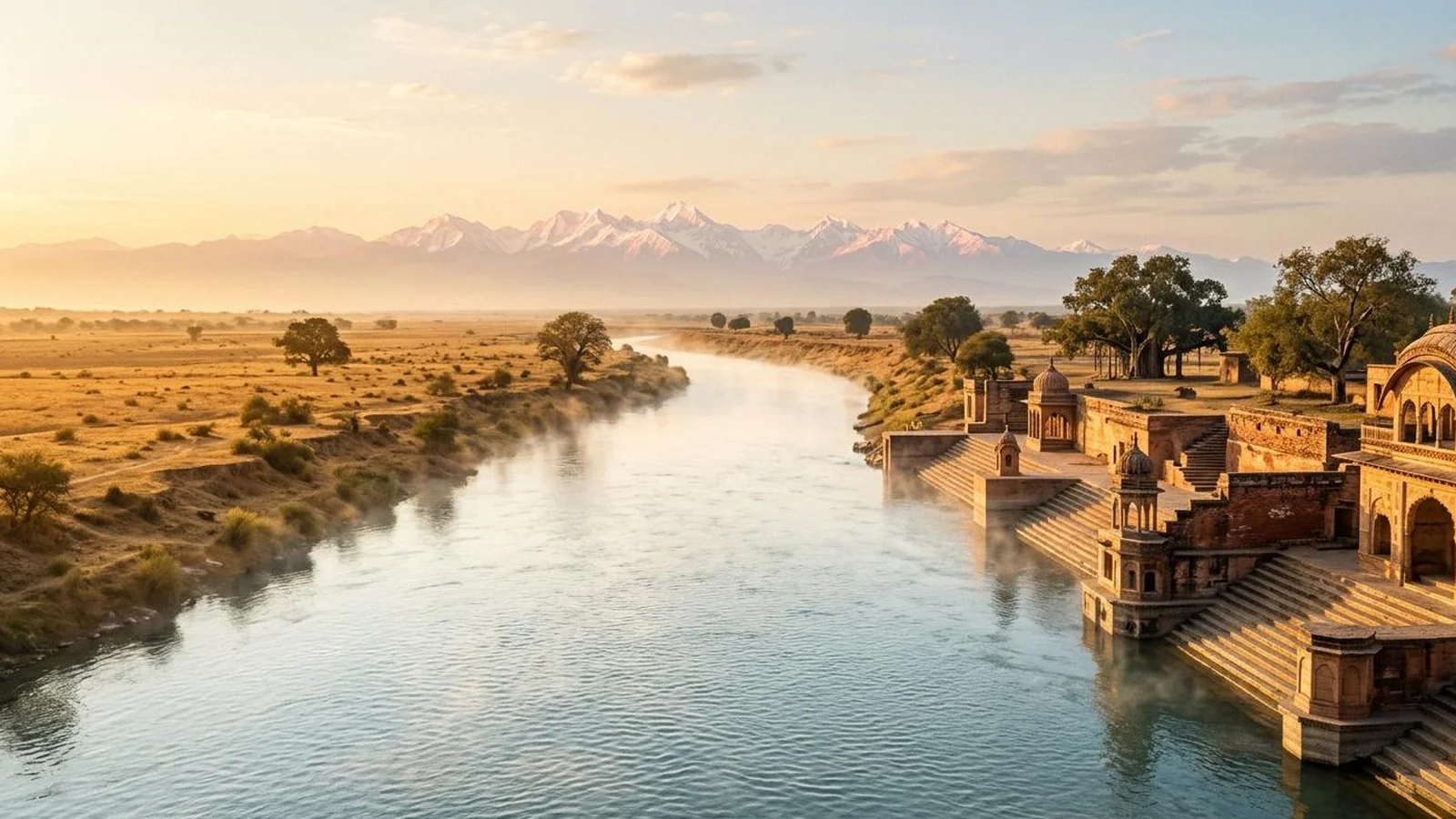
The River Sarasvati stands at the crossroads of Vedic scripture, ancient Indian geography, and modern space-age geology. Revered in the Rigveda as Ambitame, Naditame, Devitame—”best of mothers, best of rivers, best of goddesses”—Sarasvati was no abstract poetic invention. For centuries, however, after the mighty Himalayan waterway dried up and disappeared beneath the sands of Haryana and Rajasthan, historians debated whether it had ever existed as a physical river.
Over the past four decades, satellite remote sensing from the Indian Space Research Organisation (ISRO), groundwater isotope dating, and archaeological excavations across northwestern India have transformed that debate. Beneath the seasonal Ghaggar-Hakra basin lies a vast, buried paleochannel network—stretching from the Himalayan foothills to the Arabian Sea—lined with hundreds of Bronze Age settlements.
In this comprehensive guide, we examine the exact Sanskrit verses of the Rigveda praising the River Sarasvati, trace the geological and ISRO satellite evidence for its ancient course, explore its later reverence in the Mahabharata and Puranas, and bridge its outer geography with the inner yogic symbolism of Vak (sacred speech) and Sushumna.
Table of Contents
Primary Sanskrit Shlokas & Translations from the Rigveda
The Rigveda Samhita celebrates Sarasvati more frequently than any other river, devoting three full hymns (6.61, 7.95, and 7.96) and dozens of verses across Mandalas 1, 2, 3, and 10 to its majesty. Two verses in particular capture both its spiritual eminence and its physical geography—starting with Sage Gritsamada’s celebrated invocation in Rigveda 2.41.16:
Devanagari (Rigveda 2.41.16):
अम्बितमे नदीतमे देवितमे सरस्वति ।
अप्रशस्ता इव स्मसि प्रशस्तिमम्ब नस्कृधि ॥ १६ ॥IAST Transliteration:
ambitame nadītame devitame sarasvati |
apraśastā iva smasi praśastim amba nas kṛdhi || 16 ||
|—|—|—|—|
Word-by-Word Breakdown (Rigveda 2.41.16):
- Ambitame (अम्बितमे): O best and most nurturing of mothers (superlative of ambā, mother).
- Nadītame (नदीतमे): O foremost and mightiest among all rivers (superlative of nadī, river).
- Devitame (देवितमे): O supreme among radiant goddesses (superlative of devī).
- Sarasvati (सरस्वति): O Sarasvati (“she who is full of flowing waters and wisdom”).
- Apraśastā iva smasi (अप्रशस्ता इव स्मसि): We are, as it were, without renown or distinction.
- Praśastim amba naḥ kṛdhi (प्रशस्तिमम्ब नस्कृधि): O Mother, grant us true distinction, clarity, and noble praise.
Equally decisive for physical geography is Sage Vasishtha’s testimony in Rigveda 7.95.2, which explicitly states the river’s origin and terminus:
Devanagari (Rigveda 7.95.2):
एकाचेतत्सरस्वती नदीनां शुचिर्यती गिरिभ्य आ समुद्रात् ।
रायश्चेतन्ती भुवनस्य भूरेर्घृतं पयो दुदुहे नाहुषाय ॥ २ ॥IAST Transliteration:
ekācetat sarasvatī nadīnāṃ śucir yatī giribhya ā samudrāt |
rāyaś cetantī bhuvanasya bhūrer ghṛtam payo duduhe nāhuṣāya || 2 ||
Here, Vasishtha declares that Sarasvati, “chief and pure among rivers, flowing from the mountains to the ocean (giribhya ā samudrāt),” nourished abundant settlements and sustained the lineage of Nahusha with prosperity and life-giving waters.
Scriptural Geography: From the Rigveda to the Mahabharata
Reading Vedic and post-Vedic texts in chronological sequence reveals a remarkable ecological record. In the Nadistuti Sukta (Rigveda 10.75.5), the rivers of northern India are listed geographically from east to west: Ganga, Yamuna, Sarasvati, Sutudri (Sutlej), Parushni (Ravi). This places the Rigvedic Sarasvati squarely between the Yamuna to the east and the Sutlej to the west—precisely where the modern Ghaggar-Hakra basin lies.
By the time of the Panchavimsha Brahmana (25.10) and the Mahabharata (Shalya Parva and Vana Parva), however, the river’s hydrology had drastically changed. These texts record Vinashana—the exact region in the desert where the once-mighty Sarasvati disappeared beneath the sands. Far from being contradictory, the shift from Rigveda 7.95.2 (“flowing from the mountains to the ocean”) to the Mahabharata’s account of its disappearance preserves an accurate multi-millennial memory of climate and river capture.
ISRO Satellite Mapping & Paleochannel Science
In the late twentieth and early twenty-first centuries, space-based Earth observation allowed geologists to test whether a perennial river system truly existed between the Yamuna and Sutlej. Using multi-spectral optical imagery (IRS P3 WiFS, IRS P6 LISS-III, Landsat) and synthetic aperture radar (Radarsat), scientists at ISRO’s National Remote Sensing Centre published the Integrated Study on River Saraswati (ISRO/NRSC Technical Report).
- Wide Buried Paleochannels: Satellite imagery and digital elevation models revealed a continuous paleochannel belt—in places 6 to 12 kilometers wide—running from the Siwalik foothills in Haryana and Punjab through northern Rajasthan (along the Ghaggar-Hakra course) and down toward the Rann of Kachchh in Gujarat.
- Himalayan Glacial Ancestry: Geological and sedimentological analyses indicate that ancient tributaries connected to the Sutlej (west) and Yamuna/Tons (east) once fed this central channel before tectonic uplift and river piracy redirected the Sutlej westward into the Indus and the Yamuna eastward into the Ganga.
- Trapped Freshwater Aquifers: Hydrogeological drilling and radiometric dating reported in the ISRO study confirmed deep freshwater aquifers trapped beneath the arid Thar Desert along the paleochannel, with groundwater ages spanning from ~1,340 to 8,910 years BP (and older Pleistocene horizons up to ~18,800 years BP).
Archaeology Along the Ghaggar-Hakra: The Indus-Sarasvati Heartland
When satellite paleochannel maps are overlaid with Bronze Age archaeological surveys, a striking pattern emerges. More than a thousand Harappan (Indus-Sarasvati) settlements cluster densely along the dry Ghaggar-Hakra-Chautang corridor—significantly outnumbering sites along the Indus mainstem itself. Major urban centers such as Rakhigarhi (Haryana), Banawali, Kalibangan (Rajasthan), and Dholavira (Gujarat, near the coastal terminus) thrived along this fertile belt.
As monsoon intensity weakened around 2200–1900 BCE and Himalayan tributaries shifted away, the perennial flow dwindled into a seasonal monsoon stream. Urban populations gradually migrated eastward toward the Ganga-Yamuna plains and southward into Gujarat, mirroring the exact historical transition preserved in later Vedic literature—just as our earlier study of the Prithvi Sukta of the Atharvaveda highlights the Vedic civilization’s deep ecological awareness of rivers, soil, and climate.
Inner & Outer Correspondence: From Sacred River to Goddess of Wisdom
In Vedic philosophy, outer nature and inner consciousness are always intertwined. Because sages meditated, composed hymns, and debated truth along the luminous banks of the Sarasvati, the river itself became synonymous with inspired speech (Vak), sacred knowledge, and rhythmic harmony—a lineage directly connected to the Vak Sukta (Devi Sukta) and Samaveda Chanting & Nada Brahma.
In yogic anatomy, the physical triad of Ganga, Yamuna, and Sarasvati meeting at Prayagraj (Triveni Sangam) maps directly onto the subtle nervous system: Ida Nadi (cooling lunar channel, Ganga), Pingala Nadi (warming solar channel, Yamuna), and Sushumna Nadi (the hidden central channel of awakening, Sarasvati). Just as the outer Sarasvati flows unseen beneath the desert sands, Sushumna flows subtly within the spinal axis until awakened by stillness and breath.
River Sarasvati Comparison Table: Scriptural Timeline & Scientific Evidence
| Historical / Scriptural Phase | Key Source / Evidence | Hydrological State | Civilizational & Spiritual Significance |
|---|---|---|---|
| Early Rigvedic Era | Rigveda 2.41.16, 7.95.2, 10.75.5 | Perennial, mighty river flowing from mountains to sea | Celebrated as Naditame; heartland of early Vedic hymns |
| Mature Harappan / Indus-Sarasvati | Kalibangan, Rakhigarhi, Banawali, ISRO sediment data | Active Ghaggar-Hakra fluvial system with monsoon + paleotributary support | Dense urban network of over 1,000 Bronze Age settlements |
| Late Bronze Age Transition (~2000–1900 BCE) | ISRO paleochannel & paleoclimate studies; Panchavimsha Brahmana | River piracy (Sutlej & Yamuna shifts) + monsoon weakening | Gradual desiccation; eastward migration toward Ganga-Yamuna |
| Epic & Puranic Memory | Mahabharata (Shalya/Vana Parva) | Subterranean flow; disappears at Vinashana | Revered as invisible third stream at Prayagraj Triveni Sangam |
| Modern Remote Sensing Era | IRS LISS-III, Landsat, Radarsat, aquifer isotope dating | 6–12 km wide buried paleochannels & deep freshwater aquifers | Confirms historical river geography & guides groundwater conservation |
Common Misconceptions About the River Sarasvati
- Misconception: Sarasvati was purely a celestial metaphor with no physical river. While Sarasvati later became the presiding Devi of learning and music, Rigveda 7.95.2 and 10.75.5 explicitly describe a real geographical river located between the Yamuna and Sutlej, flowing from the mountains to the ocean.
- Misconception: The river vanished overnight in a single catastrophe. Geological and hydrological evidence points to a multi-century process driven by tectonic shifts diverting Himalayan tributaries alongside gradual Holocene monsoon aridification.
- Misconception: “Lost” means completely gone. Hydrogeological surveys show that significant freshwater aquifers still remain preserved beneath the paleochannel sands in Haryana and Rajasthan, earning Sarasvati the poetic title Antah-salila (“flowing within”).
Practical Takeaway: Reconnecting with Sarasvati’s Living Wisdom
Studying the River Sarasvati teaches us two vital lessons for modern life. Externally, its drying reminds us how deeply civilizations depend on ecological balance, watershed stewardship, and respect for rivers—values echoed across the Prithvi Sukta. Internally, Sarasvati’s quiet subterranean flow invites us to cultivate clarity of speech, lifelong study (svadhyaya), and inner stillness beneath the surface noise of daily distractions.
Read More on InVedas
- Prithvi Sukta Atharvaveda: Mother Earth Hymn & Ecology (2026)
- Vak Sukta Devi Sukta (2026): Rigveda’s Cosmic Power
- Hiranyagarbha Sukta (Rigveda 10.121): Meaning & Creation Hymn
- 14 Lokas in Vedic Cosmology: Meaning, Hierarchy & Modern Science
Frequently Asked Questions on River Sarasvati
Did the River Sarasvati really exist physically?
Yes. Remote sensing imagery from ISRO (IRS and Landsat satellites), ground-penetrating resistivity surveys, and archaeological mapping of over 1,000 Harappan settlements along the Ghaggar-Hakra basin confirm that a major ancient river system once flowed from the Himalayan foothills through Haryana and Rajasthan toward the Arabian Sea.
Where is River Sarasvati mentioned in the Rigveda?
Sarasvati is praised over 70 times in the Rigveda, including three dedicated hymns (6.61, 7.95, and 7.96). In Rigveda 2.41.16 it is called Ambitame, Naditame, Devitame (‘best of mothers, rivers, and goddesses’), and in Rigveda 7.95.2 it is described as flowing pure from the mountains to the ocean.
What caused the River Sarasvati to dry up?
Geological studies indicate that tectonic shifts diverted its major Himalayan tributaries—the Sutlej westward to the Indus and the Yamuna eastward to the Ganga—combined with a weakening of the Indian summer monsoon around 2200–1900 BCE.
How does River Sarasvati connect to the Indus Valley Civilization?
Archaeological surveys show that a dense concentration of Bronze Age settlements—including major cities like Rakhigarhi, Kalibangan, and Banawali—lies along the Ghaggar-Hakra paleochannel, leading many researchers to refer to the broader culture as the Indus-Sarasvati Civilization.
Why is Sarasvati called invisible at Prayagraj’s Triveni Sangam?
In later Vedic and Puranic tradition, after the physical river went underground in the desert (Vinashana), Sarasvati was revered as Antah-salila (flowing beneath the surface), symbolizing the subtle central Sushumna Nadi uniting with Ida (Ganga) and Pingala (Yamuna) in yogic anatomy.
Closing Reflection
The story of the River Sarasvati bridges ancient Vedic memory and twenty-first-century Earth observation. What the rishis sang of beside Himalayan-fed waters thousands of years ago has now been traced from orbit—reminding us that Sanatana Dharma’s sacred texts carry enduring historical, ecological, and spiritual truth.
For an expansive exploration of India’s cultural tapestry, sacred geographies, and living traditions, explore Pardeep’s definitive work: Many Faces of India.