The Purusha Sukta Rigveda stands as one of the most sublime, universally revered, and spiritually profound hymns in the entire corpus of Vedic literature. Found in the tenth mandala of the Rigveda (Mandala 10, Sukta 90), this magnificent composition offers an awe-inspiring vision of cosmic creation, divine immanence, and the ultimate unity underlying the entire universe. It bridges the gap between the infinite, unmanifest Absolute and the finite, tangible cosmos we experience daily.
As seekers of Sanatan wisdom, understanding this sacred text unlocks the foundational worldview of Vedic philosophy, where divinity is not distant or separate from creation, but rather coextensive with it. In this comprehensive guide, we will explore the historical origin, structure, authentic Sanskrit verses with IAST transliteration, word-by-word meanings, core philosophical tenets, and practical modern applications of the Purusha Sukta.
Table of Contents
1. Origin and Structure of Purusha Sukta
The Purusha Sukta Rigveda comprises sixteen powerful mantras dedicated to the cosmic personification known as Mahapurusha or Paramatman. While it belongs primarily to the Rigveda (10.90), variant recensions of this hymn also appear in the Yajurveda (such as the Vajasaneyi Samhita), the Samaveda, and the Atharvaveda, testifying to its paramount importance across all Vedic schools.
Structurally, the hymn can be divided into two distinct theological movements:
- The Immanent Vision (Mantras 1-5): Describes the cosmic Purusha, who possesses a thousand heads, eyes, and feet, pervading the entire universe while transcending it by ten fingers’ breadth.
- The Cosmic Sacrifice (Mantras 6-16): Utilizes the metaphor of a primordial yajna (sacrifice) performed by the Devas, through which the manifest universe—including the cosmos, seasons, animals, social order, and celestial realms—is emanated from the body of the Purusha.
To fully grasp how Vedic cosmology categorizes the manifest universe arising from such divine principles, one can explore the intricate hierarchy detailed in our study on 14 Lokas in Vedic Cosmology.
2. Authentic Sanskrit Shlokas and Translation
Let us examine the opening mantra of the Purusha Sukta in Devanagari script, followed by its IAST transliteration and direct English translation.
ॐ सहस्रशीर्षा पुरुषः सहस्राक्षः सहस्रपात् ।
स भूमिं विश्वतो वृत्वात्यतिष्ठद्दशाङ्गुलम् ॥ १ ॥Om Sahasra-śīrṣā puruṣhaḥ sahasrākṣhaḥ sahasra-pāt |
Sa bhūmiṁ viśvato vṛtvā-atyatiṣṭhad-daśāṅgulam || 1 ||Meaning: The Purusha has a thousand heads, a thousand eyes, and a thousand feet. Pervading the earth on all sides, He transcends it by ten fingers’ breadth (exceeding all limitation).
This verse immediately establishes that the Supreme Reality is infinite, unbounded by time and space, yet intimately present in every atom of creation. The use of “thousand” is a traditional Vedic expression signifying infinity and inexhaustible multiplicity.
3. Padachheda and Word-by-Word Analysis
To appreciate the linguistic and metaphysical depth of the Purusha Sukta Rigveda, let us break down the key terms of the first mantra through grammatical and lexical analysis (Padachheda):
| Sanskrit Term (Padachheda) | Grammatical Root / Form | Literal Meaning |
|---|---|---|
| सहस्रशीर्षा (Sahasra-śīrṣā) | Sahasra (thousand) + śīrṣan (head) | One with a thousand heads (infinite intellects/points of view) |
| पुरुषः (Puruṣhaḥ) | Puru + ṣha (that which dwells in the city/body) | The Cosmic Consciousness / Supreme Spirit |
| सहस्राक्षः (Sahasrākṣhaḥ) | Sahasra (thousand) + akṣha (eye) | One with a thousand eyes (all-seeing witness) |
| सहस्रपात् (Sahasra-pāt) | Sahasra (thousand) + pāda (foot) | One with a thousand feet (omnipresent foundation) |
| विश्वतः (Viśvataḥ) | From viśva (universe) + tas | From all sides / universally |
| दशाङ्गुलम् (Daśāṅgulam) | Daśa (ten) + aṅgula (finger breadth) | Transcending physical measurement by ten fingers |
Through this meticulous construction, the rishis convey that while the entire universe is sustained by the divine, the source of that universe remains transcendent, untouched by the limitations of material decay.
4. Core Philosophical Analysis
The philosophical apex of the Purusha Sukta Rigveda lies in its synthesis of monism (Advaita) and sacrificial cosmology. Verse two declares:
पुरुष एवेदं सर्वं यद्भूतं यच्च भव्यम् ।
उतामृतत्वस्येशानो यदन्नेनातिरोहति ॥ २ ॥Puruṣha evedaṁ sarvaṁ yad-bhūtaṁ yac-cha bhavyam |
Utāmṛtatvasyeśāno yad-annenātirohati || 2 ||Meaning: All this—whatever has been and whatever shall be—is verily the Purusha. He is also the lord of immortality, growing even beyond (transcending) what thrives by food.
This verse serves as a bedrock for later Vedantic thought, directly anticipating the declarations of the Upanishads. It asserts that the material universe is not separate from the Divine; rather, creation is an emanation of the Supreme Self. Furthermore, similar to how the Katha Upanishad Chariot Analogy guides the individual soul toward mastery over the senses and the intellect, the Purusha Sukta elevates the human mind to contemplate the macrocosmic chariot of the universe driven by the supreme consciousness.
5. Practical Modern Application
How does an ancient cosmic hymn resonate in our fast-paced modern lives? The wisdom of the Purusha Sukta offers profound practical utilities:
- Eco-Spiritual Awareness: By viewing the entire natural world as the limbs of the cosmic Purusha, ecological preservation becomes an act of direct worship. Harming nature is recognized as harming the divine body.
- Universal Equality: The allegorical emergence of societal functions from the Purusha’s body emphasizes interdependence. True Sanatan philosophy views all segments of society as vital organs of a single cosmic organism.
- Mindfulness and Meditation: Chanting the Purusha Sukta anchors the practitioner in a state of expanded awareness, dissolving egoic isolation by recognizing the same divine spark in every living entity.
Read More on InVedas
- Agni Sukta Rigveda (2026): Meaning, Shlokas & Fire Wisdom
- 33 Koti Devtas Explained: The Vedic Science of 33 Cosmic Principles
- Isha Upanishad Verse 1 (2026): Meaning & Non-Attachment
- Mandukya Upanishad AUM: 4 States of Consciousness (2026)
Frequently Asked Questions
What is the Purusha Sukta in Rigveda?
The Purusha Sukta is the 90th hymn of the 10th Mandala of the Rigveda. It is a foundational cosmic hymn that describes the Supreme Person (Purusha) as the source, sustainer, and transcendent reality behind the entire universe.
Which Mandala of the Rigveda contains the Purusha Sukta?
It is located in the 10th Mandala (Rigveda 10.90), which generally contains hymns dealing with deep philosophical inquiries, creation theories, and cosmological marriage or funeral rites.
Who is the Rishi associated with the Purusha Sukta?
The seer (Rishi) credited with receiving the Purusha Sukta is Narayana Rishi, and the deity (Devata) praised in the hymn is Purusha (Paramatman).
Why is the Purusha Sukta important in daily Vedic rituals?
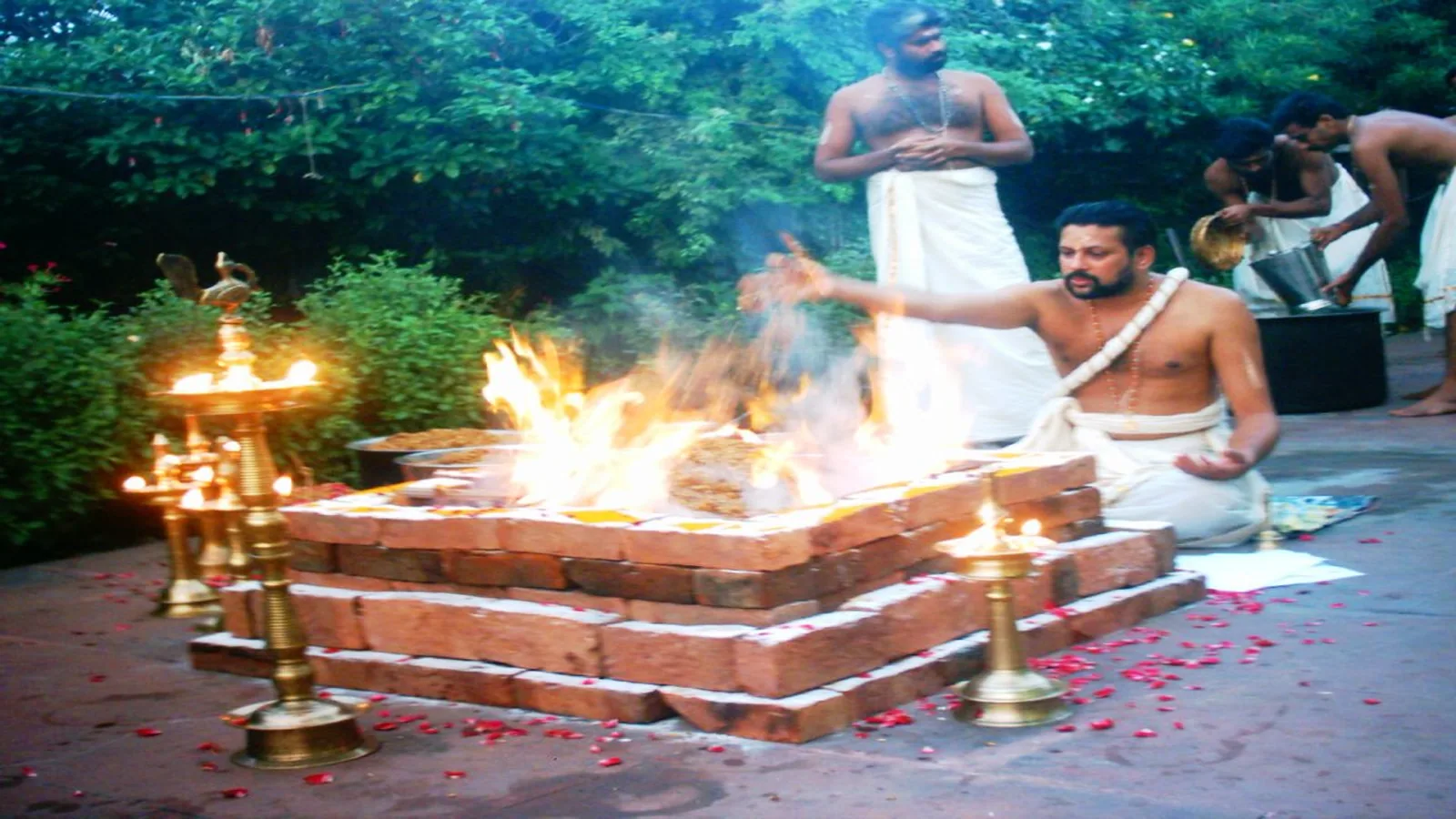
It is frequently chanted during major Vedic homas (fire rituals), abhishekas (deity ablutions), and ancestral rites (shraddha) because it invokes the supreme cosmic presence to sanctify the offerings and purify the environment.
How does the Purusha Sukta relate to Advaita Vedanta?
The hymn’s declaration that “all this is verily the Purusha, past and future” directly supports non-dualistic (Advaita) philosophy by establishing that the universe and the Creator are fundamentally non-different.
Om Shanti, Shanti, Shantiḥ. May peace prevail in the physical realm, the mental realm, and the spiritual realm.