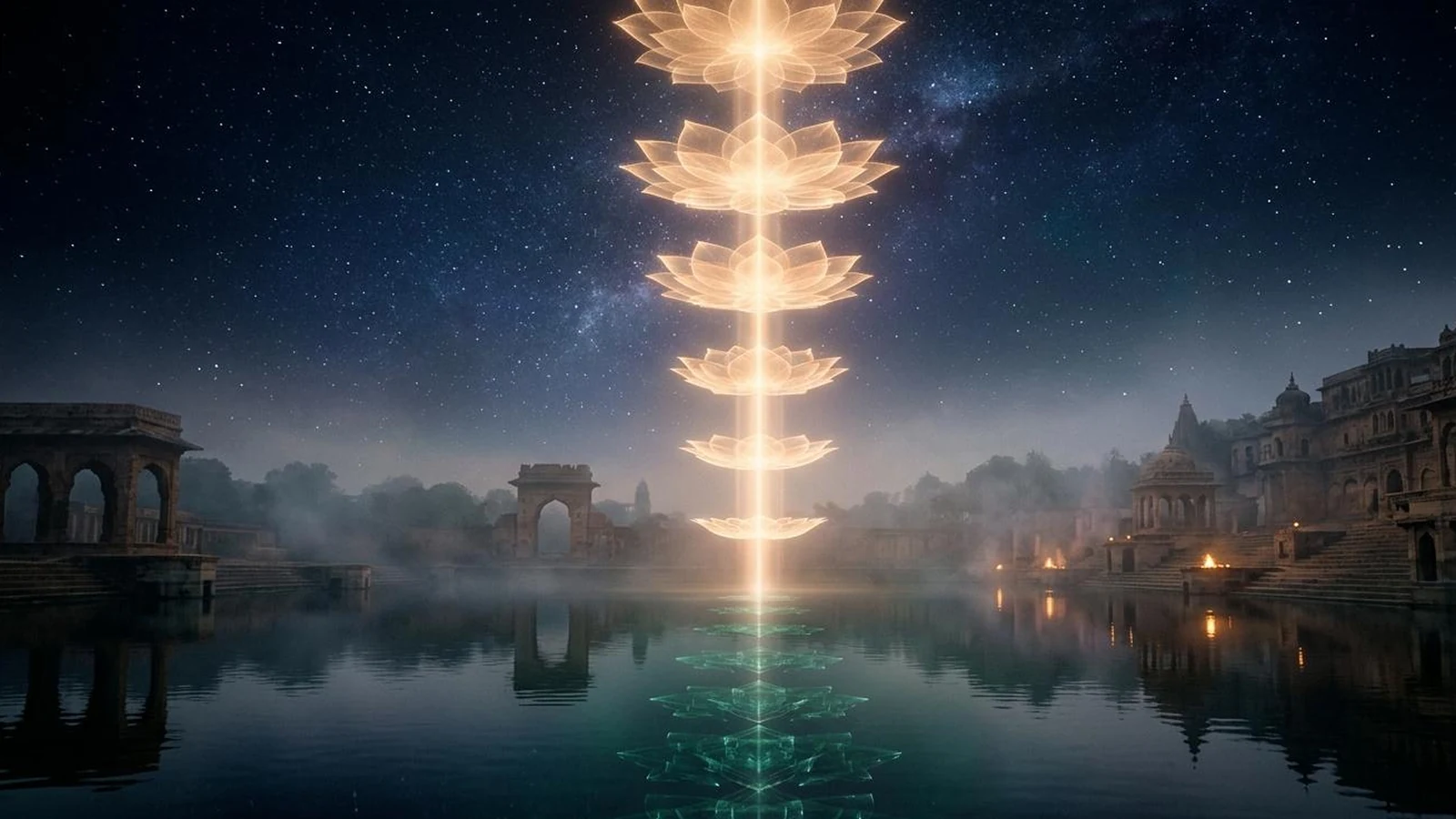
The 14 Lokas (Chaturdasha Bhuvana) form the grand architectural map of Vedic cosmology, describing a multidimensional universe organized into seven ascending planes of consciousness and seven descending realms of dense manifestation. Far from being poetic guesswork or simple geography, this fourteenfold cosmos integrates astronomical observation, inner yogic anatomy, and metaphysical ontology into a single coherent system.
Every day across India, practitioners invoke the upper seven planes through the sacred Vyahritis—Bhuh, Bhuvah, Suvah, Mahah, Janah, Tapah, Satyam—before chanting the Gayatri Mantra. Yet many seekers are unaware that these seven planes, paired with the seven subterranean realms from Atala to Patala, represent distinct states of subtle matter, time perception, and awareness.
In this comprehensive guide, we trace the 14 Lokas through the Taittiriya Upanishad, Vishnu Purana, Brihaddharma Purana, and Srimad Bhagavatam, examine how the fourteen realms correspond to the human chakra system, and explore remarkable parallels with modern higher-dimensional physics and brane cosmology.
Table of Contents
Primary Sanskrit Mantra & Upanishadic Foundation
The Vedic root of the upper cosmic planes appears in the Taittiriya Upanishad (Shiksha Valli 1.5.1), which introduces the sacred utterances (Vyahritis) as cosmic dimensions resting within Brahman, and reaches its full sevenfold liturgical form in the Mahanarayana Upanishad and classical Gayatri invocation:
Devanagari (Sapta Vyahritis):
ॐ भूः । ॐ भुवः । ॐ स्वः । ॐ महः ।
ॐ जनः । ॐ तपः । ॐ सत्यम् ॥IAST Transliteration:
oṃ bhūḥ | oṃ bhuvaḥ | oṃ svaḥ | oṃ mahaḥ |
oṃ janaḥ | oṃ tapaḥ | oṃ satyam ||
Word-by-Word Breakdown:
- Om Bhūḥ (ॐ भूः): The physical plane of earthly existence and gross matter (Bhurloka).
- Om Bhuvaḥ (ॐ भुवः): The atmospheric and vital mid-region between earth and sun (Bhuvarloka).
- Om Svaḥ (ॐ स्वः): The celestial realm of solar light and heavenly harmony (Svarloka).
- Om Mahaḥ (ॐ महः): The great luminous plane of expansive cosmic intelligence (Maharloka), revealed by Sage Mahachamasya in Taittiriya Upanishad 1.5.1.
- Om Janaḥ (ॐ जनः): The realm of pure creative progeny and illumined sages (Janaloka).
- Om Tapaḥ (ॐ तपः): The plane of concentrated spiritual austerity and radiant wisdom (Tapoloka).
- Om Satyam (ॐ सत्यम्): The highest manifest plane of unshakeable Truth, the abode of Brahma (Satyaloka).
Scriptural Origin of the 14 Lokas: From the Vedas to the Puranas
In the oldest Vedic Samhitas, the universe is first described as a threefold division (Trailokya): Earth (Prithivi), Mid-space (Antariksha), and Heaven (Dyaus)—the very three realms across which the 33 Koti Devtas are invoked in Rigveda 1.139.11. As contemplative cosmology matured in the Upanishads and Puranas, this three-tiered sky expanded into seven ascending upper worlds (Urdhva Lokas) and seven descending lower worlds (Adho Lokas).
Texts such as the Brihaddharma Purana (Chapter 5), Vishnu Purana (Book 2, Chapters 5–7), and Srimad Bhagavatam (Canto 5) map the entire cosmic egg (Brahmanda) around a central planetary plane (Bhurloka), with six luminous realms rising above it and seven subterranean or subtle-material realms extending beneath it.
Crucially, the Narada Purana distinguishes Bhurloka (specifically Bharatavarsha) as Karmabhumi—the unique field of moral choice and spiritual action—while higher and lower worlds function primarily as Bhogabhumi, realms where the fruits of prior karma are experienced.
The 7 Upper Lokas (Urdhva Lokas): Ascending Planes of Light
The seven upper lokas represent progressively subtler dimensions of energy, lifespan, and spiritual clarity, stretching from the physical earth up to the summit of manifested creation:
- Bhurloka (भूर्लोक): The physical earth and terrestrial biosphere where gross matter (Pancha Mahabhutas) predominates. It is the primary arena of embodied human evolution, dharma, and self-discovery.
- Bhuvarloka (भुवर्लोक): The atmospheric and astral mid-region extending from earth to the solar sphere, inhabited by subtle spirits, Siddhas, and Munis, and governed by vital life-force (Prana).
- Svarloka / Svarga (स्वर्लोक): The celestial realm between the sun and the pole star (Dhruva), presided over by Indra and the Devas. Souls who perform righteous action without full non-attachment experience luminous joy here, though residency remains temporary until merit is exhausted.
- Maharloka (महर्लोक): The vast plane above the pole star where great sages like Bhrigu reside. Unlike the lower three worlds, Maharloka survives the partial dissolution at the end of a cosmic day (Kalpa), though its inhabitants ascend higher during intense cosmic heat.
- Janaloka (जनलोक): The realm of pure creative mind, home to the four mind-born Kumaras (Sanaka, Sanandana, Sanatana, and Sanatkumara) who remain eternally free of egoic attachment.
- Tapoloka (तपोलोक): The plane of radiant spiritual tapas (concentrated inner fire), inhabited by advanced beings who have transcended sensory desire and dwell in uninterrupted contemplation.
- Satyaloka / Brahmaloka (सत्यलोक): The apex of manifested creation, the abode of Creator Brahma. Here, dualistic delusion dissolves into pure truth; beings who attain Satyaloka do not return to mortal rebirth, achieving gradual liberation (Krama Mukti) at the end of the cosmic cycle.
The 7 Lower Lokas (Adho Lokas / Bilasvarga): Subterranean Realms of Density
Descending beneath Bhurloka lie seven realms collectively called Bilasvarga (“subterranean heavens”). Contrary to common mistranslations, these are not realms of torment or damnation. As the Srimad Bhagavatam (Canto 5, Chapter 24) describes, these seven planes are illuminated by radiant gemstones rather than sunlight, filled with architectural splendor, and inhabited by Daityas, Danavas, and Nagas deeply immersed in sensory pleasure:
- Atala (अतल): The first lower plane, characterized by intoxicating sensory enchantment and attachment to material power.
- Vitala (वितल): Governed by Hatakeshvara (a form of Shiva), where alchemical gold (Hataka) flows and artistic craft flourishes.
- Sutala (सुतल): Famous as the noble kingdom of King Bali, guarded by Lord Vishnu in His Vamana form as a reward for Bali’s extraordinary devotion and surrender.
- Talatala (तलातल): Ruled by the master architect Maya Danava, symbolizing technological mastery and illusion divorced from higher wisdom.
- Mahatala (महातल): The abode of multi-headed celestial serpents (Krodhavasha Nagas), representing powerful instinctual drives.
- Rasatala (रसातल): The realm of fierce elemental pride and territoriality, inhabited by the Panis and Nivatakavachas.
- Patala (पाताल): The seventh and deepest subterranean plane, also called Nagaloka, ruled by Vasuki and crowned by the luminous hood-jewels of cosmic serpents, resting above the cosmic support of Adi Sesha.
Inner Correspondence: The 14 Lokas Within the Human Body
In Vedic and Tantric science, outer cosmology is always mirrored inside the human subtle body (Yatha Pinde Tatha Brahmande). Just as we saw in our exploration of the Pancha Koshas and the Vastu Purusha Mandala, the 14 Lokas correspond directly to levels of consciousness along the spinal axis (Sushumna Nadi):
- Seven Upper Lokas & the Seven Chakras: Bhurloka aligns with Muladhara (base/earth stability); Bhuvarloka with Svadhisthana (water/vital flow); Svarloka with Manipura (solar fire); Maharloka with Anahata (heart/expansive air); Janaloka with Vishuddha (throat/creative sound); Tapoloka with Ajna (third eye/pure insight); and Satyaloka with Sahasrara (crown/unified Truth).
- Seven Lower Lokas & Subconscious Drives: In yogic psychology, the seven planes below Muladhara represent descending layers of instinctual conditioning, sensory craving, territorial fear, and dormant karmic tendencies—which must be acknowledged and integrated rather than repressed.
Modern Science Parallels: Higher Dimensions, Brane Cosmology & Dark Sectors
While ancient Sanskrit texts use symbolic and experiential language, their core insight—that observable physical reality is only one thin slice of a multi-layered, higher-dimensional cosmos—resonates deeply with modern theoretical physics.
- Extra Spatial Dimensions & Brane Worlds: Physicists at CERN actively investigate models in which our familiar three-dimensional world is a “brane” (membrane) embedded inside a higher-dimensional bulk space. In this framework, other realms or fields can coexist alongside our universe without being directly visible to ordinary electromagnetic sensors.
- The 95% Unseen Universe: According to CERN’s overview of fundamental physics, the Standard Model describes only about 4–5% of the cosmos (ordinary baryonic matter). The remaining ~95% consists of dark matter and dark energy—reinforcing the Vedic premise that Bhurloka (ordinary visible matter) is only one band in a far wider cosmic spectrum.
- Time Dilation Across Realms: Puranic cosmology famously notes that time flows at vastly different rates across lokas—a single day in Satyaloka (one Kalpa of Brahma) equals 4.32 billion human years—echoing how modern relativity demonstrates that time is not absolute, but varies with gravitational potential and reference frames.
- Non-Dual Consciousness Beyond All 14 Lokas: Just as the Mandukya Upanishad points to Turiya beyond waking, dreaming, and deep sleep, Vedanta teaches that Brahman transcends all fourteen lokas as their silent, unchanging substratum.
14 Lokas Comparison Table: Upper & Lower Realms
| Plane Group | Loka (Sanskrit) | Presiding / Key Inhabitants | Inner Chakra / State | Core Cosmic Quality |
|---|---|---|---|---|
| Upper (7) | Satyaloka | Brahma, liberated sages | Sahasrara (Crown) | Unconditioned Truth, Krama Mukti |
| Upper (6) | Tapoloka | Vairaja & ascetic masters | Ajna (Third Eye) | Concentrated tapas, pure insight |
| Upper (5) | Janaloka | Four Kumaras (Sanaka et al.) | Vishuddha (Throat) | Pure creative intellect, non-attachment |
| Upper (4) | Maharloka | Bhrigu & cosmic rishis | Anahata (Heart) | Expansive cosmic harmony |
| Upper (3) | Svarloka | Indra, Devas, Gandharvas | Manipura (Solar) | Celestial joy, meritorious fruition |
| Upper (2) | Bhuvarloka | Siddhas, Munis, subtle beings | Svadhisthana | Vital pranic atmosphere |
| Upper (1) | Bhurloka | Humans, animals, plants | Muladhara (Base) | Karmabhumi—physical action & choice |
| Lower (1–3) | Atala, Vitala, Sutala | Bala, Hatakeshvara, King Bali | Subconscious attachment | Sensory wealth, craft, devotion in form |
| Lower (4–7) | Talatala, Mahatala, Rasatala, Patala | Maya Danava, Nagas, Vasuki | Deep instinctual drives | Technological illusion, primal power, subterranean light |
Common Misconceptions About the 14 Lokas
- Misconception: The 7 lower lokas (Atala–Patala) are “Hell.” In Sanatana Dharma, the lower lokas are prosperous subterranean planes (Bilasvarga). Corrective karmic realms (Naraka) are entirely separate and temporary, located below Patala in Puranic geography.
- Misconception: The 14 Lokas are stacked only like physical floors in space. While texts use vertical metaphors (above and below) for pedagogical clarity, they describe differing vibrational densities and perceptual dimensions rather than simple altitude.
- Misconception: Reaching Svarga (Svarloka) is the final goal of Hinduism. As the Bhagavad Gita and Mundaka Upanishad emphasize, heavenly lokas are temporary; true liberation (Moksha) lies in realizing the changeless Self beyond all fourteen realms.
Practical Takeaway: Elevating Your Daily “Loka” of Awareness
In daily life, you do not have to wait for another lifetime to experience the 14 Lokas—you shift between them through your quality of attention. When driven purely by sensory craving or territorial fear, awareness contracts into lower-loka patterns. When you act with integrity in Bhurloka, steady your breath in Bhuvarloka, cultivate gratitude in Anahata, and practice quiet truth-seeking in Tapoloka, you consciously align your inner life with the highest planes of Vedic wisdom.
Read More on InVedas
- 33 Koti Devtas Explained: The Vedic Science of 33 Cosmic Principles
- Mandukya Upanishad AUM: 4 States of Consciousness (2026)
- Hiranyagarbha Sukta (Rigveda 10.121): Meaning & Creation Hymn
- Pancha Koshas Explained: The 5 Sacred Sheaths of Consciousness in Vedanta & Science
Frequently Asked Questions on the 14 Lokas
What are the 14 Lokas in Hinduism?
The 14 Lokas (Chaturdasha Bhuvana) are the seven upper worlds (Bhurloka, Bhuvarloka, Svarloka, Maharloka, Janaloka, Tapoloka, and Satyaloka) and seven lower worlds (Atala, Vitala, Sutala, Talatala, Mahatala, Rasatala, and Patala) described in Vedic and Puranic cosmology.
Are the 7 lower lokas (Patala) the same as Naraka (hell)?
No. In Puranic texts such as the Srimad Bhagavatam, the seven lower lokas from Atala to Patala are called Bilasvarga (subterranean heavens) filled with gemstone light and material splendor. Naraka is a separate, temporary corrective realm located beneath Patala.
How do the 7 upper lokas connect to the Gayatri Mantra?
Before chanting the Gayatri Mantra, practitioners recite the seven sacred Vyahritis—Om Bhuh, Om Bhuvah, Om Suvah, Om Mahah, Om Janah, Om Tapah, Om Satyam—which directly invoke and align consciousness with the seven upper lokas.
How do the 14 Lokas map onto the human body and chakras?
Yogic tradition maps the seven upper lokas onto the seven chakras along the spine, from Bhurloka at Muladhara (base) up to Satyaloka at Sahasrara (crown), while the seven lower lokas correspond to subconscious drives and latent karmic conditioning below the base chakra.
Which loka is considered Karmabhumi?
Bhurloka—specifically Bharatavarsha—is described in the Narada Purana and other Puranas as Karmabhumi, the unique realm where beings possess free moral choice to perform dharma and attain liberation, whereas other lokas are primarily Bhogabhumi (realms for experiencing karmic results).
Is there a modern physics parallel to the 14 Lokas?
Yes. Theoretical physicists at CERN and elsewhere study extra spatial dimensions and brane cosmology—where our visible 3D world coexists with hidden higher-dimensional spaces—alongside relativistic time dilation, echoing Vedic descriptions of multi-layered realms with differing rates of time.
Closing Reflection
The 14 Lokas reveal a universe alive with consciousness at every scale—from the dense crystalline depths of Patala to the luminous stillness of Satyaloka. By understanding these planes not merely as distant sky-realms but as living dimensions reflected within our own awareness, we gain a timeless compass for living with clarity, balance, and purpose right here on Earth.
For an expansive exploration of India’s cultural tapestry, sacred geographies, and living traditions, explore Pardeep’s definitive work: Many Faces of India.
ॐ One Reflection on “14 Lokas in Vedic Cosmology: Meaning, Hierarchy & Modern Science”